Showing posts with label COSTA CONCORDIA (Passenger ship). Show all posts

Tuesday, October 15, 2013

COSTA CONCORDIA deverá ser transportado pela Dockwise


A companhia COSTA, filial italiana do Grupo Carnival, de Miami, contratou a empresa holandesa Boskalis para efectuar o transporte do malogrado paquete COSTA CONCORDIA, da ilha de Grigio, para local a indicar onde deverá ser desmantelado. O navio deverá ser transportado a bordo do DOCKWISE VANGUARD, o maior navio-plataforma do mundo, que se vê nas imagens, fornecidas pela empresa Dockwise.

O Grupo Carnival tem vindo a sofrer reveses sucessivos devido a acidentes e incidentes protagonizados por navios das suas companhias de cruzeiros, em especial desde a tragédia do COSTA CONCORDIA. Este Domingo, dia 13 de Outubro registou-se a bordo do paquete CARNIVAL VICTORY o afogamento acidental de uma criança de 6 anos, numa das piscinas do navio. Mais um incidente a prejudicar a imagem da companhia.
Texto e imagens /Text and images copyright L.M.Correia. Favor não piratear. Respeite o meu trabalho / No piracy, please. For other posts and images, check our archive at the right column of the main page. Click on the photos to see them enlarged. Thanks for your visit and comments. Luís Miguel Correia

Wednesday, January 16, 2013

COSTA CONCORDIA

Cost of removing Costa Concordia may hit $530M : More time and money will be needed to remove the Costa Concordia from the rocks off Tuscany where it capsized 
last year, in part to ensure the toxic materials still trapped inside don't leak into the marine sanctuary when it is righted, officials said Saturday.
On the eve of the first anniversary of the grounding, environmental and salvage experts gave an update on the 
unprecedented removal project underway, stressing the massive size of the ship — 102,000 tonnes, its precarious perch on the rocks off Giglio island's port and the environmental concerns at play.
The pristine waters surrounding Giglio are part of a protected marine sanctuary for dolphins, porpoises and whales, and are a favourite for scuba divers. Already, tourism was off 28 per cent last year thanks in part to the eyesore in Giglio's port, and officials say the hulking vessel now won't be removed before the end of this summer.
Franco Gabriele, the head of Italy's civil protection agency, told reporters that officials were now looking at September as the probable date for removal, taking into account conservative estimates for poor weather and rough seas. 
Originally, officials had said they hoped to have it removed in early 2013. In addition, Gabriele and Costa officials said the cost might now reach about $530 million, up from the $400 million originally estimated.
The Concordia slammed into a reef off Giglio on Jan. 13, 2012, after the captain took it off course in a stunt to bring it closer to the island. As it took on water through the 70-metre gash in its hull, the Concordia rolled onto its side and came to rest on the rocks off Giglio's port. Thirty-two people were killed. 'During the rollover and floating operations, there could be some leaking.' —Maria Sargentini, head of environmental oversight group The captain, Francesco Schettino, remains under house arrest, accused of multiple manslaughter, causing a shipwreck and leaving the ship before all passengers were evacuated. He hasn't been charged. Schettino maintains he saved lives by bringing the ship closer to shore and claims the reef wasn't on his nautical charts.
Salvage crews successfully removed some 1,900 tonnes of fuel last year from the ship's tanks without any major spill. But Maria Sargentini, president of the environmental oversight group for the Concordia, said sewage, remaining fuel and tons of rotten food remain inside. "Sure, there are still some risks," she said Saturday. "Especially during the rollover and floating operations, there could be some leaking." The complicated removal plan involves constructing an underwater platform and attaching empty tanks on the 
exposed side of the ship. The cisterns will be filled with water, and cranes attached to the platform will be used to rotate the ship and pull it upright. Once upright, the ship will have cisterns attached to the other side. All the cisterns will be emptied of water and filled with air to help float the ship and free itself from the seabed. Once it's properly afloat, it can then be towed to a nearby seaport for demolition. On Sunday, relatives of the dead and some survivors are expected to flock to Giglio for a daylong commemoration that will honour the victims, those who rescued them and the residents of Giglio who opened their doors to the survivors. Source : CBC and Shipping News Clippings.
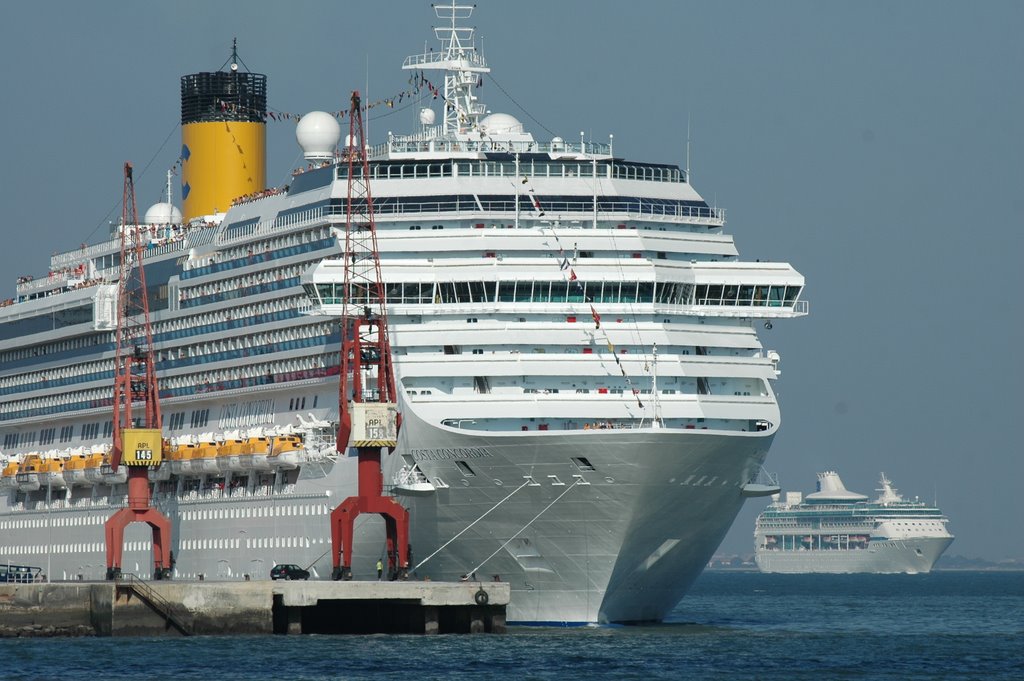
Imagens do paquete COSTA CONCORDIA registadas em Lisboa durante a escala inaugural deste navio no Tejo a 19 de Julho de 2006.
Texto e imagens /Text and images copyright L.M.Correia. Favor não piratear. Respeite o meu trabalho / No piracy, please. For other posts and images, check our archive at the right column of the main page. Click on the photos to see them enlarged. Thanks for your visit and comments. Luís Miguel Correia

Monday, January 16, 2012

More on COSTA CONCORDIA

Terry Hutson's Report (PORTS & SHIPS): The maritime professionals’ union Nautilus International says in a statement issued yesterday that Friday night’s grounding of the cruise ship COSTA CONCORDIA carrying 3200 passengers and a crew of about 1000, just two weeks into the Titanic centenary year, should serve as a wake-up call to the shipping industry and those who regulate it.
Nautilus – which represents 23,000 ship masters, officers, ratings and other shipping industry staff – says the incident involving the Italian-flagged cruise ship off the Italian coast is the latest in a series that have highlighted its long-standing concerns over safety.

By late Sunday five people were confirmed dead and another 15 remained missing. Earlier a honeymoon couple from South Korea were rescued from low down in the ship where they had been trapped and unable to make their way up onto the decks with other passengers. At least one other person remained on board waiting to be rescued. Search parties heard him yesterday calling for help but hadn’t yet managed to locate or identify the man.
Rescued passengers told of panic and chaos on board the ship, and claimed that regulation lifeboat drills had not bee carried out but were scheduled for the next morning.
“In this, the centenary of the loss of the Titanic, major nostalgia industry is already in full flow – but it is essential that everyone recognises that the Titanic offers lessons for today and that there are contemporary resonances that should not be lost,” said Nautilus’ general secretary Mark Dickinson.
In particular, Nautilus says it is concerned about the rapid recent increases in the size of passenger ships – with the average tonnage doubling over the past decade.
“Many ships are now effectively small towns at sea, and the sheer number of people onboard raises serious questions about evacuation,” Mr Dickinson pointed out.
“Nautilus is by no means alone in voicing concern at underlying safety issues arising from the new generation of ‘mega-ships’ – whether they be passenger vessels carrying the equivalent of a small town or containerships with more than 14,000 boxes onboard. Insurers and salvors have also spoken about the way in which the sheer size and scale of such ships presents massive challenges for emergency services, evacuation, rescue, and salvage - and we should not have to wait for a major disaster until these concerns are addressed.
“The growth in the size of such ships has also raised questions about their watertight integrity and fire-fighting protection,” Dickinson added. “In an address to a conference on the safety of large passenger ships in 2000, the then secretary-general of the International Maritime Organisation, William O’Neil, cited 12 passenger ship accidents in the previous six years and noted “…in retrospect we can see that it was to some extent a matter of luck – good weather, calm seas, and other ships in the vicinity, for example – that very few lives were lost.”
“We believe that more attention needs to be given to such issues as the adequacy of life-saving appliances, and the quality and quantity of crews and their training and experience in operating these vessels and dealing with emergency situations, including evacuation,” Mr Dickinson said.
According to Nautilus it is essential that inquiries into the Costa Concordia grounding examine reports of an electrical problem onboard – an issue on which the union raised concern following an explosion and loss of power onboard Cunard’s Queen Mary 2.
It is essential that ships are built for safety, with adequate redundancy rather than a prescriptive minimum, the Union argues.
It says the inquiries should also address human factor issues including seafarers’ working hours and adequate manning of bridge and engine room. Investigations also need to focus on crew competence and training issues.
The Union is calling for a thorough review of regulations governing the construction and operation of passenger vessels - in particular, standards of stability and watertight integrity. Attention needs to be paid to existing evacuation systems and more innovative systems for abandonment.
Yesterday the BBC reported experts as saying they are puzzled as to why such a modern and well-equipped vessel should have run aground in well-charted waters.
The report described the ship as having been in calm waters sailing along a familiar route. The mystery is why it diverted from its course by between 3 and 4 miles, and why the ship capsized so quickly. “This will be central for investigators trying to establish the cause of the accident.”
It says the investigation will focus on why a modern ship, “with the latest safety equipment, travelling on the same route it travels 52 times every year, seemingly veered off course and hit what the cruise company has described as ‘a big rock’.
“There are a large number of possibilities ranging from human error, to technical failure, to a combination of the two. “It is possible the crew simply made a mistake and steered off course. They may have been misled by faulty navigation equipment.” The ship’ master is reported to have said that the rock which the ship hit is not on any chart currently in use.
What is known is that the accident occurred while some passengers were still at dinner in the various restaurants. Others were being entertained at a magician’s show in the theatre up in front of the ship. When the collision occurred and the ship began to list, the magician disappeared and some passengers said they thought it was all part of the show.
Others would have been in their cabins or staterooms, or on deck. Passengers described a long rumbling grating noise coming from underneath the ship. It was later discovered that a 41m gash had opened part of the lower hull, admitting the sea and leading to the ship ultimately capsizing. The collision was followed by all electrical power being lost, which added to the chaos among passengers. About an hour later, with the ship’s list becoming pronounced, the order was given to abandon ship but by then the list was too great for lifeboats on one side to be lowered.
A number of passengers or crew jumped overboard amid some reports of panic among passengers. Later reports said the master of the ship had left the vessel before all his passengers were safely in lifeboats or had been lifted ashore.
The captain, Francesco Schettino, and first officer, Ciro Ambrosio, have meanwhile been arrested and could face multiple homicide charges and having abandoned the ship before the passengers were rescued, the Italian police and media reported.
Costa Cruises, the Carnival Corporation division that operates the Costa Concordia has begun to apportion the blame, saying “It seems that the commander made errors of judgement that had serious consequences,” while adding that he had not followed company procedures in his management of the emergency.
Carnival Corporation, the owner of Costa Cruises said in a statement that it was deeply saddened by the accident and was working to fully understand the cause of what happened.
It said that “on 13 January 2012, Costa Cruises’ vessel, the Costa Concordia, departed from Civitavecchia, Italy with approximately 3,200 passengers and 1,000 crew members on a seven-day voyage. At approximately 10:00pm CET, the vessel struck [a] rock off the coast of Isola del Giglio, Italy and sustained significant damage causing the ship to list severely. The order was given to abandon ship and deploy the lifeboats.”
One of the drawbacks of accident enquiries is that they are conducted by the flag state concerned – in this case Italy. With passenger ships such as Costa Concordia carrying a large number of people from other parts of the world it might be preferable if a neutral body was appointed by the IMO to look into such incidents and accidents. There is sometimes too much national pride involved for total confidence that all flag states will set about understanding and explain all the relevant facts.
An accident such as this one can take up to a year before the inquiry reports are completed, despite the existence of a so-called ‘blackbox’ which contains a large amount of technical and human information up to the moment of the collision and capsizing. This includes voice monitoring from the bridge. Source BBC, Nautlius, Paul Ridgway (London) and own source
Texto e imagens /Text and images copyright L.M.Correia. Favor não piratear. Respeite o meu trabalho / No piracy, please. For other posts and images, check our archive at the right column of the main page. Click on the photos to see them enlarged. Thanks for your visit and comments. Luís Miguel Correia

Some thoughts regarding the COSTA CONCORDIA

News here in merry ole' England is all but ablaze with the COSTA CONCORDIA story ... from being off course to the Captain leaving too soon and to emptying the ship's safe as a first priority ... Carnival Corp, which owns Costa Cruises as part of its 100-liner empire, has now had a 16% drop in stock value (in London, of course) and, while there are questons about the $650 million CONCORDIA, they forsee a minimum of $100 in claims, rescue, expensses, etc ... the 114,000-ton ship was insured, as of Friday, for $515 million ... and of course there has been an immediate drop in general bookings, and not only for the 14-ship Costa fleet, but all others ... vacationers momentarily loose faith, some quickly scuttling travel plans.
But aspects of the story are not entirely new: when the American liner EXCALIBUR left NY in June 1950, for example, she went off course, just off Brooklyn no less, rammed a freighter & soon flooded and all but sank herself. The Captain, it was said, in the later investigation, wanted to wave goodbye to his wife & so veered off course ... and when the big liner CONSTITUTION was arriving, again in NY harbor, in March 1959, she sliced a Norwegian tanker in two in foggy conditions. Seems the liner was going far too fast because the Captain wanted to make an 11am dentist appm't in Manhattan ... and when the cruise liner RIVIERA was burning & sinking off Cuba in April 1966, the Italian capt & his officers were in the first 2 lifeboats, with the ship's safe onboard no less and, it was said, the monies were already divided among them before even reaching shore. There are many other tales as well.
Today, I have been tracked down & asked to appear on a TV show in nearby Manchester (that's England too, of course) and a live radio show in London, and of course all regarding & commenting on the COSTA CONCORDIA tragedy.
Photo of COSTA CONCORDIA in Lisbon on her maiden cruise, July 2006.
Texto de Bill Miller e imagens LMC /Text by Bill Miller and images copyright L.M.Correia. Favor não piratear. Respeite o meu trabalho / No piracy, please. For other posts and images, check our archive at the right column of the main page. Click on the photos to see them enlarged. Thanks for your visit and comments. Luís Miguel Correia

IN THE WAKE of the CONCORDIA DISASTER


Posted: 15 Jan 2012 11:20 AM PST 
by Anne Campbell 
It has taken me 24 hours to write about the Costa Concordia’s disastrous cruise from Rome which resulted in five deaths and the latest estimate of 17 missing passengers because I’ve been covering the cruise industry for almost two decades.   I know that Carnival Corporation, which owns Costa Cruises, is a leader  in terms of building vessels that meet the highest safety specifications.  (Photo:  Solaro/AFP/Getty Images)
It was astonishing to see photos of a five year old 115,000 -ton cruise ship lying on its side roughly 600 feet from shore, hearing the harrowing tales of passengers swimming to shore, the utter pandemonium and panic of abandoning a
 dark listing ship.   Not only is it the 100th anniversary of the sinking of Titanic but some of the details are scarily similar: a 950-foot gash in the ship’s hull that looks like someone tried to open it with a can opener coupled with people jumping in the water, the crew unable to launch many of the ship’s lifeboats and utter panic.
I attended this ship’s splashy Italian christening in 2006, toured half-built ships in dozens of visits to European shipyard,  spent a great deal of time over the years interviewing ship builders and cruise line execs about cruise ship safety.  I’ve written that the only threat to a modern cruise ship is fire.
So, how could this happen to cruise ship in the 21st century?
The answer is that we won’t know for sure until Costa Concordia’s little black box reveals moment-by-moment sequence of events that resulted in the 4,000-passenger vessel crashing on rocks of Isola del Giglio on the Italian Riviera.  At present the ship’s master, Captain Francesco Schettino, has been arrested, charged with multiple manslaughter, causing a shipwreck and abandoning ship.   In an interview, the visibly distraught Captain said the “rocks not detected” on the navigational chart. Three people trapped inside the ship have been rescued as the search for 17 missing people continues.
The Details
On January 13, Costa Concordia had set sail from Civitavecchia (port of Rome) on a seven day cruise at 4:00 p.m. with scheduled port calls in Savonna, Marseille, Barcelona, Palma de Mallorca, Cagliari and Palermo. Seas were calm and the Italian officers certainly knew this itinerary well since Concordia sails on this fixed itinerary each week.   On board the vessels were 3200 passengers and a crew of 1000.  International maritime laws stipulate that a mandatory lifeboat drill must take place within 24 hours of departing the port of embarkation and, as is quite common in this industry, Concordia’s was scheduled the following morning.
Shortly before 10:00 p.m. there was a sudden “boom and crash” followed by loss of electricity as water began spilling into the ship.  Costa Concordia immediately started to list and passengers in the main dining room report that dishes and glasses crashed to the floor.  An announcement from the bridge told passengers not to panic, that everything was under control.
But passengers and crew did panic   There are reports of people being shoved down stairways as people raced to their staterooms to don life jackets.  After 45 minutes the order to abandon ship created more chaos since passengers didn’t know where to go.  In an interview one passenger said he was unable to board a lifeboat and swam to shore while a video taken on board a lifeboat illustrates how terrified its passengers were.   Because the ship was listing many lifeboats couldn’t be launched.
While it may be true that the only real threat to a cruise ship is fire, there are clearly two other factors which can turn a cruise into a disaster:  technical problems and human error.  An example of the first is Carnival Splendor, which lost power in 2010 off the coast of Mexico.   While the ship sat in the ocean for days there was nothing remotely frightening or dangerous about the experience.   As for human error, we’ve seen that since the first human went to sea.
Again, nobody knows what caused this terrible accident.  But several maritime experts interviewed about Costa Concordia expressed the a concern — ships carrying thousands of people have become too large to evacuate everyone safely.
For further information……….
BBC has the most comprehensive information and video interviews.
I was very dismayed to read that ships in Costa Cruises (headquartered in Rome) fleet have had a larger than normal number of mishaps.   See the report in the Daily Mirror (UK)


Texto CruiseCritics e imagens LMC /Text CruiseCritics and images copyright L.M.Correia. Favor não piratear. Respeite o meu trabalho / No piracy, please. For other posts and images, check our archive at the right column of the main page. Click on the photos to see them enlarged. Thanks for your visit and comments. Luís Miguel Correia

Saturday, January 14, 2012

COSTA CONCORDIA stranded and half sunk

Shocking news on the tragic accident suffered by COSTA CONCORDIA last night in the Mediterranean.
First a photograph of the ship when new, taken in Lisbon on her inaugural cruise and mainden call to Lisbon in July 2006, and below how she is now...
All very sad and there are victims who lost their lives...
Second and third photos taken from the internet. Photo one copyright LMC. On the third photo the damage to the underwater part of the hull is clearly seen. After a disaster like this we are going to have SOLAS 2013 and new rules ahead...
See more COSTA CONCORDIA related posts and photos...
Texto e imagens /Text and images copyright L.M.Correia. Favor não piratear. Respeite o meu trabalho / No piracy, please. For other posts and images, check our archive at the right column of the main page. Click on the photos to see them enlarged. Thanks for your visit and comments. Luís Miguel Correia

Tragédia do COSTA CONCORDIA

Trata-se do mais grave acidente ocorrido com um navio de cruzeiros da actual geração: o COSTA CONCORDIA, de 114.000 GT sofreu um rombo de 70 metros na zona da popa e começou a afundar ontem à noite, junto à ilha italiana de Grigio. 
Tudo indica que o navio está perdido, pois encontra-se adornado por estibordo, deitado no fundo baixo junto a um banco de areia. Tudo aconteceu cerca das 22H00 locais, 21H00 em Portugal, e o navio havia largado horas antes de Civitavecchia, o porto de cruzeiros próximo de Roma, num cruzeiros de 7 dias. Hoje devia estar em Savona, o porto base da Costa onde grande parte dos passageiros ia desembarcar. Dos cerca de mais de 4000 passageiros e tripulantes a bordo, há a registar pelo menos 6 mortos, dezenas de feridos, alguns graves, e muito possivelmente o paquete estará perdido.
Não há ainda informação para as causas desta tragédia que incluiu cenas de pânico a bordo e muitas dificuldades para localizar e salvar passageiros idosos e com mobilidade reduzida. Não me espanta que haja erro humano associado ao desastre. A proximidade de terra facilitou a assistência aos náufragos mas tudo indica que as dificuldades foram muitas. Aguardemos por mais notícias.
Estive no COSTA CONCORDIA no cruzeiro inaugural deste belo navio de passageiros em 2006. Era um grande paquete...
Fotografias retiradas do site italiano PAZZO PER IL MARE da autoria de Laura Montanaro. 
Texto e imagens /Text and images copyright L.M.Correia. Favor não piratear. Respeite o meu trabalho / No piracy, please. For other posts and images, check our archive at the right column of the main page. Click on the photos to see them enlarged. Thanks for your visit and comments. Luís Miguel Correia

COSTA CONCORDIA: Sexta-feira 13...

O grande navio de cruzeiros italiano COSTA CONCORDIA sofreu esta noite um acidente grave no Mediterraneo e encalhou junto à ilha de Giglio, quando navegava de Civitavecchia para Savona, com 4320 passageiros e tripulantes a bordo. Segundo notícias, o navio foi evacuado havendo a registar a perda de diversas vidas não sendo as notícias muito seguras em termos de números, de 2 a 6....
Caso para referir ser uma Sexta-feira 13 para a Costa Crociere e o paquete COSTA CONCORDIA...
O COSTA CONCORDIA é um navio ultra moderno, construído em Itália em 2006. Ver mais informações e imagens relativas a este navio aqui... Fotografia retirada da internet referindo que o navio se estava a afundar, com uma inclinação de 20 graus...
Italian cruise ship COSTA CONCORDIA damaged and running aground in the Mediterranean with 3200 passengers and 1100 crew members onboard, in the evening of 13 January 2012, while on a cruise from Civitavecchia to Palermo in the Western Mediterranean.
Texto e imagens /Text and images copyright L.M.Correia. Favor não piratear. Respeite o meu trabalho / No piracy, please. For other posts and images, check our archive at the right column of the main page. Click on the photos to see them enlarged. Thanks for your visit and comments. Luís Miguel Correia

Thursday, March 25, 2010

COSTA CONCORDIA leaving the river Tagus

Italian cruise ship COSTA CONCORDIA leaving the river Tagus mouth on 23 March 2010 on a transatlantic positioning voyage.
Texto e imagens /Text and images copyright L.M.Correia. For other posts and images, check our archive at the right column of the main page. Click on the photos to see them enlarged. Thanks for your visit and comments. Luís Miguel Correia

Thursday, July 20, 2006

COSTA CONCORDIA: HOMENAGEM DA APL


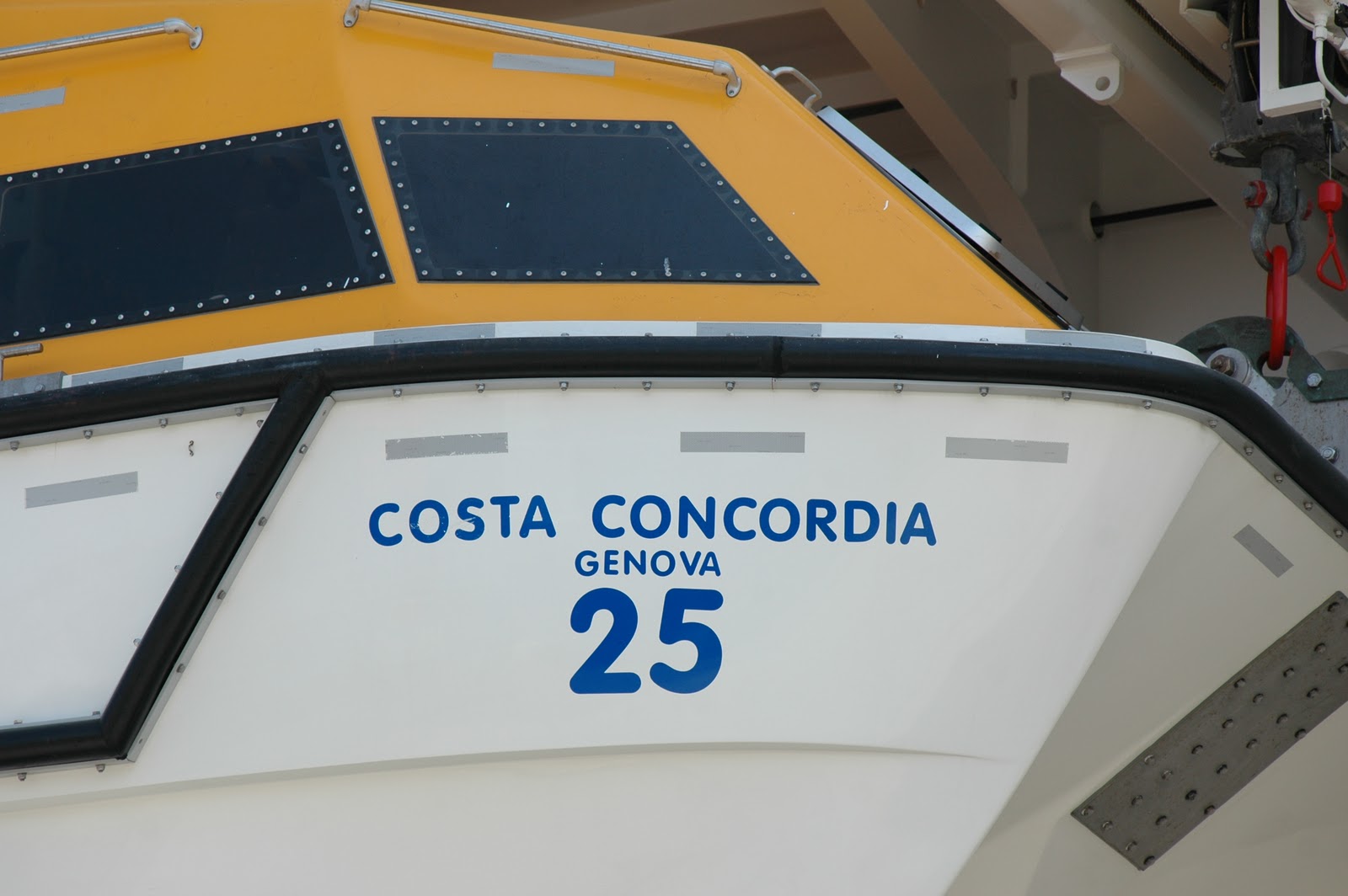
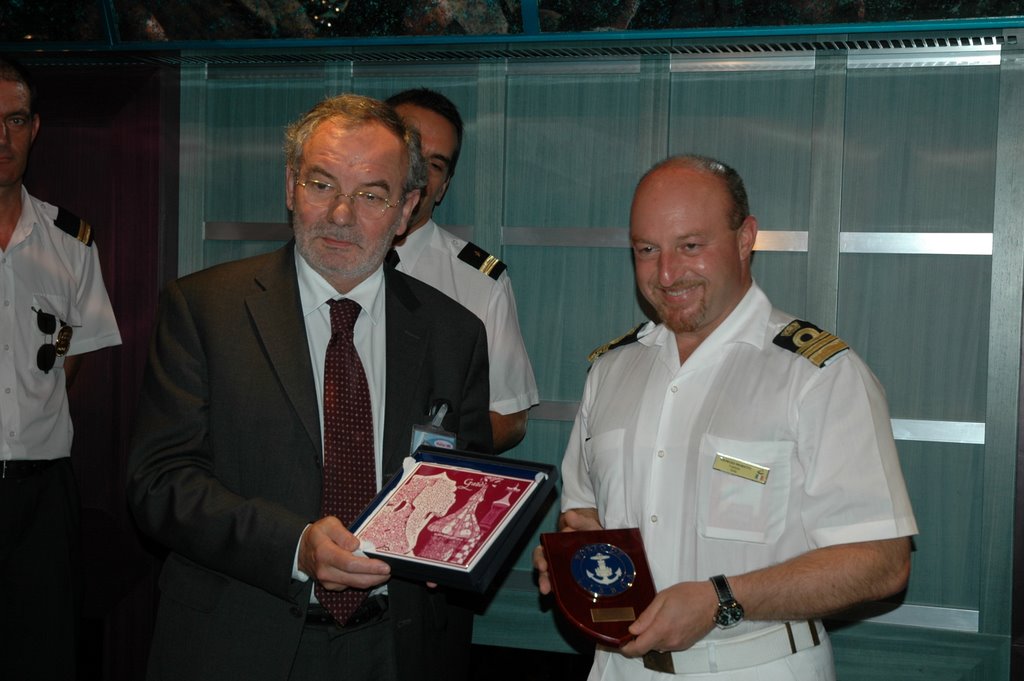
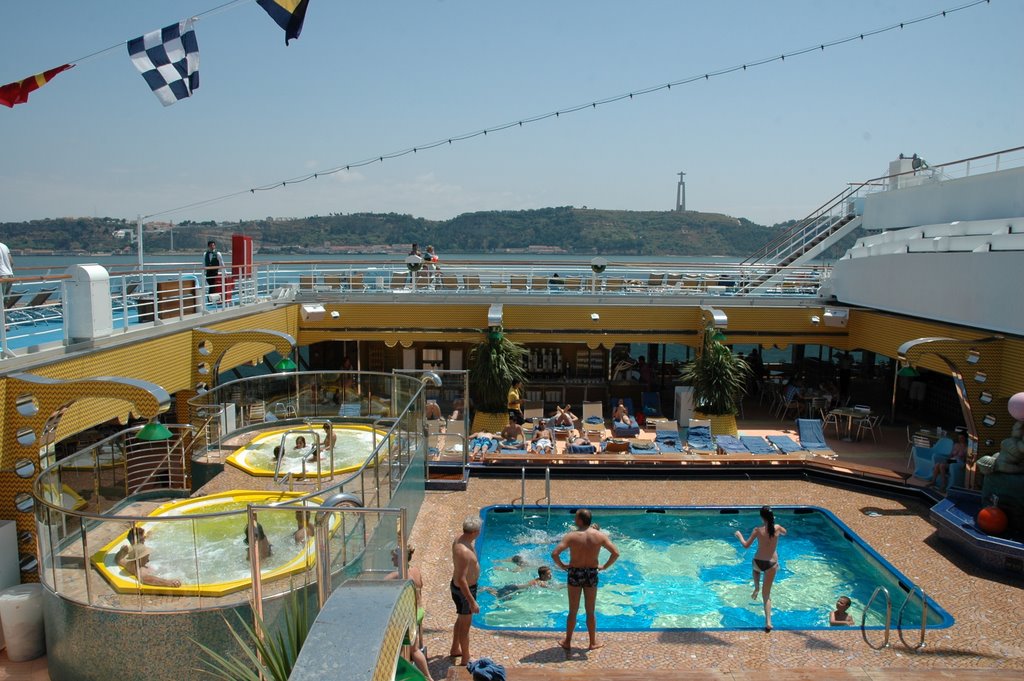
O COSTA CONCORDIA largando de Lisboa para Cádis. Em baixo, troca de lembranças entre o Cte. do navio e o Dr. Marques Afonso, da APL e aspectos de pormenor do COSTA CONCORDIA


Assinalando a primeira escala em Lisboa do novo paquete COSTA CONCORDIA, ocorrida a 19-07-2006, a Administração do Porto de Lisboa promoveu uma homenagem ao navio, que decorreu a bordo, com a presença de diversas autoridades e responsáveis pela APL, os quais foram recebidos pelo comandante do COSTA CONCORDIA. Efectuou-se uma troca de presentes, a que se seguiu uma apresentação e visita ao navio. O COSTA CONCORDIA largou para Cádis pelas 18h10. Em 16-09 deve passar em Lisboa, igualmente pela primeira vez, o navio gémeo COSTA MÁGICA, que está a operar no Norte da Europa.
Texto e fotos de Luís Miguel Correia. Todos os direitos de autor e reprodução reservados. Não piratear - 2006