Monday, January 17, 2011

Lanche das gaivotas

Comida! Commmmmida! e as gaivotas tentam cada uma a sua sorte nesta dança de festa protagonizada por um elemento da tripulação do rebocador SVITZER LISBOA em partilha de pão com as gaivotas de Lisboa numa tarde de sol de inverno, ali junto às escadinhas da sanidade, ao cais da Rocha...
Fotografia de 26 de Dezembro de 2010
Texto e imagens /Text and images copyright L.M.Correia. For other posts and images, check our archive at the right column of the main page. Click on the photos to see them enlarged. Thanks for your visit and comments. Luís Miguel Correia

Sunday, January 16, 2011

GIL EANNES NO MUSEU DE MARINHA

O Museu de Marinha de Lisboa tem um espaço dedicado ao navio-hospital GIL EANNES (II) de 1955, com um belíssimo modelo, o sino que pertenceu aos dois navios com este nome, e a capela original que foi retirada do navio quando da sua venda para a sucata, antes de ter sido salvo miraculosamente e rebocado de Alhos Vedros para Viana do Castelo, onde se encontra preservado.
Aqui fica a sugestão de uma visita dupla: ao Museu de Marinha de Lisboa e a Viana, ao próprio navio GIL EANNES...


Texto e imagens /Text and images copyright L.M.Correia. For other posts and images, check our archive at the right column of the main page. Click on the photos to see them enlarged. Thanks for your visit and comments. Luís Miguel Correia

Thursday, January 13, 2011

CORVETAS CLASSE BAPTISTA DE ANDRADE

Duas das três corvetas da classe BAPTISTA DE ANDRADE ainda no activo, fotografadas em Portimão a 23 de Maio de 2010: apenas alguns pormenores de navios que servem a nossa Marinha há quase 40 anos... Em primeiro plano a corveta NRP JOÃO ROBY.


Texto e imagens /Text and images copyright L.M.Correia. For other posts and images, check our archive at the right column of the main page. Click on the photos to see them enlarged. Thanks for your visit and comments. Luís Miguel Correia

Wednesday, January 12, 2011

299 escalas de cruzeiros em 2010 no Tejo

Em 2010, com 448 497 passageiros de cruzeiro o porto de Lisboa registou um novo recorde transpondo, assim, os 415 758 turistas contabilizados em 2009, o que traduz um crescimento de 8%.
Este crescimento foi particularmente determinado pelo aumento de 19% do número de passageiros em trânsito, que totalizaram 395 884, retomando-se, assim, a trajectória crescente registada neste segmento de mercado até 2008.
No que diz respeito às escalas, o porto de Lisboa registou, em 2010, um total de 299 escalas, o que corresponde a um crescimento de 2% face às 294 escalas ocorridas em 2009, recuperando, assim, a tendência de crescimento verificada nos anos anteriores. À semelhança do sucedido ao nível dos passageiros, também o aumento das escalas foi impulsionado pelo segmento trânsito, que teve um incremento de 13%.
As 299 escalas foram realizadas por 111 navios de cruzeiro, o que constitui, também, um novo recorde.
Importa ainda referir que, em 2010, o porto de Lisboa recebeu em primeira escala 19 navios, sendo que 10 eram novos, ou seja, saídos de estaleiro durante o ano transacto, o que reforça a importância crescente que o porto de Lisboa tem vindo a assumir na inclusão dos itinerários da nova frota dos diferentes operadores.
Destaca-se, ainda, durante o ano de 2010, o mês de Setembro, tendo-se atingido valores próximos dos anos de ouro no princípio da década de 1970, em que o mês de Setembro era sempre o mais generoso em escalas, ultrapassando as 70, este ano de 2010 foram alcançados em apenas um mês, 57 escalas e 85 mil passageiros. 
Fotografia do QUEEN ELIZABETH, unidade mais recente da Cunard, que esteve em Lisboa diversas vezes na série de cruzeiros inaugurais em Outubro e Dezembro de 2010.

Texto e imagens /Text and images copyright L.M.Correia. For other posts and images, check our archive at the right column of the main page. Click on the photos to see them enlarged. Thanks for your visit and comments. Luís Miguel Correia

PONTINHA RENOVADA

O molhe da Pontinha, no porto do Funchal, foi renovado com a construção da Gare Marítima para navios de cruzeiros e está mais acolhedor e elegante do que nunca, embora com a requalificação se tenha perdido muita coisa boa, desde a acessibilidade generalizada que fazia do molhe um dos locais mais apetecíveis para os madeirenses, ao ambiente marítimos rodeado de guindastes e cargas diversas...
Aspectos da Pontinha com os paquetes QUEEN VICTORIA e SAGA PEARL II atracados no dia 30 de Dezembro de 2010.

Texto e imagens /Text and images copyright L.M.Correia. For other posts and images, check our archive at the right column of the main page. Click on the photos to see them enlarged. Thanks for your visit and comments. Luís Miguel Correia

Ainda o COIMBRA em Lisboa

Em especial para os amigos mais interessados nos bacalhoeiros, aqui ficam mais umas imagens da chegada a Lisboa do COIMBRA no passado dia 4 de Janeiro...
Um belo navio, bem conservado para a sua idade, a demonstrar a qualidade da construção naval dos antigos Estaleiros S. Jacinto, entretanto encerrados, infelizmente..

Texto e imagens /Text and images copyright L.M.Correia. For other posts and images, check our archive at the right column of the main page. Click on the photos to see them enlarged. Thanks for your visit and comments. Luís Miguel Correia

Modelo de Canoa da Picada

Conferência "Como fazer um modelo de um barco tradicional no contexto do estudo arqueológico das embarcações", que terá lugar em Sesimbra, no dia 28 de Janeiro de 2011, pelas 21h30, na Capela do Espírito Santo dos Mareantes.
Em complemento dos aspectos didácticos da palestra, na qual se procederá a uma apresentação sequencial das principais etapas da construção do modelo à escala 1/15 de uma Canoa da Picada, construído no Núcleo Naval do Ecomuseu Municipal do Seixal, serão também apresentadas algumas conclusões acerca dos processos de concepção deste género de embarcações, recorrendo a esquemas de geometrização simples.
Mais informações em http://museu.sesimbra.pt/

Texto e imagens /Text and images copyright L.M.Correia. For other posts and images, check our archive at the right column of the main page. Click on the photos to see them enlarged. Thanks for your visit and comments. Luís Miguel Correia

Tuesday, January 11, 2011

COIMBRA EM LISBOA

Acabado de aterrar em Lisboa vindo do Funchal e o arrastão COIMBRA a entrar a barra do Tejo para docar e reparar no estaleiro da Rocha (NAVALROCHA). O ano fotográfico não podia começar de melhor maneira em Lisboa...
O COIMBRA é um dos arrastões bacalhoeiros que souberam resistir às doces tentações da desmaritimização corporizadas na pesca com cheques generosos comparticipados pela UE e o Estado Português após integração do nosso País na União Europeia sem se ter negociado nem defendido as pescas condignamente. 
Em poucos anos desmantelou-se a frota do almirante Tenreiro, trocaram-se bacalhoeiros por Porches e finda a história sobraram treze resistentes - 13 verdadeiro número da sorte para os nossos bacalhoeiros - tal o número de navios que ainda temos a operar na pesca longínqua. E parece que ganham dinheiro, volta a Aveiro ou Vigo sempre carregados apesar de quase todos serem velhos, a rondar os 40 anos de mar. É o caso do COIMBRA, construído em 1973 nos Estaleiros S. Jacinto e que agora vem pintar e reparar a Lisboa, porque a doca da Navalria passou a estar ocupada na construção de navios. 
Fotografias da chegada do COIMBRA a Lisboa no dia 4 de Janeiro de 2011.


Texto e imagens /Text and images copyright L.M.Correia. For other posts and images, check our archive at the right column of the main page. Click on the photos to see them enlarged. Thanks for your visit and comments. Luís Miguel Correia 

Saturday, January 08, 2011

FUNCHAL CRUISE PICTORIAL

Port of Funchal cruise shipping pictorial on 3 January 2011, on another day full of passenger ships: AIDABLU, COSTA CONCORDIA, THOMSON SPIRIT, VOLCAN DE TIJARAFE...


Texto e imagens /Text and images copyright L.M.Correia. For other posts and images, check our archive at the right column of the main page. Click on the photos to see them enlarged. Thanks for your visit and comments. Luís Miguel Correia 

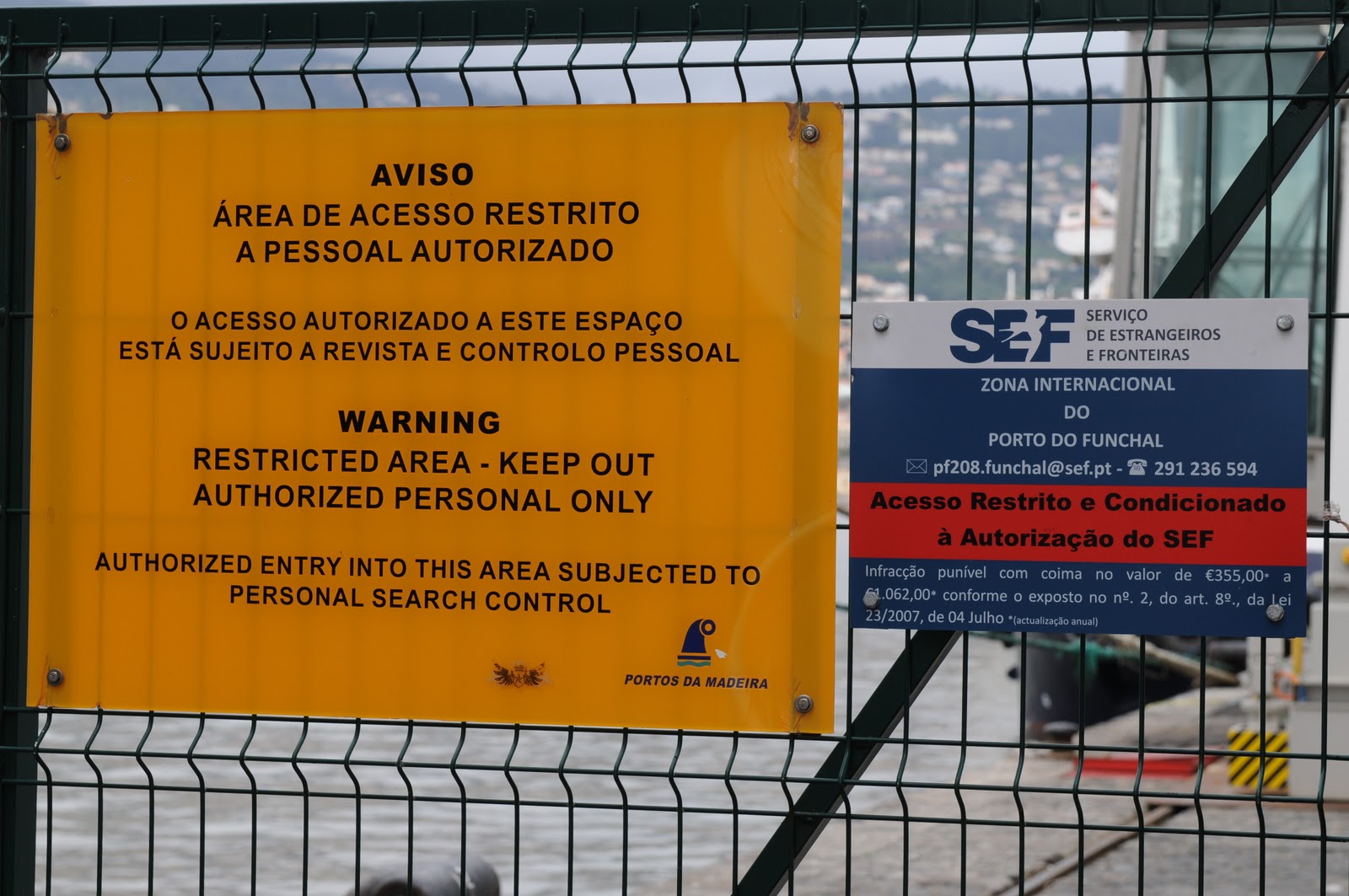
AVISO...

Diz a sabedoria popular que "quem te avisa teu amigo é..." Será mesmo? 
Estes avisos e as grades que os suportam são a fronteira física no porto de Funchal, mas podíamos estar a falar de outros portos por esse mundo americanizado em matéria securitária.
No caso do Funchal, que foi durante anos um porto lindíssimo aberto a toda a gente e um espaço de liberdade e de harmonia com os navios, a Ilha e as pessoas, estas restrições são ainda mais de lamentar, por desnecessárias, totalmente exageradas e levedas a um extremo de interpretação das normas impostas à IMO pelos americanos verdadeiramente de lamentar... Esperemos por melhores dias, que a esperança não nos tiram facilmente...
Vitimas da fortificação da Pontinha, as últimas três lanchas tradicionais da Madeira, SCOTIA, MAY e TAMISA encontram-se agora varadas no plano inclinado de S. Lázaro, depois de a empresa proprietária ter falido após proibição de operar entre o cais da cidade e a Pontinha... Fotografias tiradas a 3 de Janeiro de 2011.
Texto e imagens /Text and images copyright L.M.Correia. For other posts and images, check our archive at the right column of the main page. Click on the photos to see them enlarged. Thanks for your visit and comments. Luís Miguel Correia

Ver navios...

Este cais é o velho cais da cidade do Funchal, que em tempos era a porta de entrada na ilha, onde atracavam as lanchas que traziam os passageiros dos paquetes fundeados ao largo, até que por volta de 1962 os navios de passageiros começaram a atracar ao molhe da Pontinha.
Com os anos o cais velho foi perdendo a sua beleza, enterrado com o empreendimento da marina a poente e com o aterro dos Beatles a nascente. O ano passado novo aterro decorrente da tragédia de 20 de Fevereiro veio tirar quase todo o mar ao cais, mas da ponta ainda se podem ver os navios atracados em frente, como este navio de cruzeiros THOMSON SPIRIT ex-NIEUW AMSTERDAM de 1983, uma visita regular ao Funchal todas as Segundas-feiras. Pena que os populares na imagem estejam quase todos de costas para o navio. A culpa é da desmaritimização nacional.
Fotografia tirada a 3 de Janeiro de 2011 no Funchal.
Texto e imagens /Text and images copyright L.M.Correia. For other posts and images, check our archive at the right column of the main page. Click on the photos to see them enlarged. Thanks for your visit and comments. Luís Miguel Correia

Saturday, January 01, 2011

MAR DA MADEIRA

Mar da Madeira visto a partir da baía do Funchal ao amanhecer de 30 de Dezembro de 2010 com umas cores magníficas. 
Por entre as Desertas aproxima-se um veleiro de três mastros francês que irá passar a noite de Fim do Ano no Funchal, o BEL ESPOIR II, de Brest...


Texto e imagens /Text and images copyright L.M.Correia. For other posts and images, check our archive at the right column of the main page. Click on the photos to see them enlarged. Thanks for your visit and comments. Luís Miguel Correia

Friday, December 31, 2010

Patrulha CUANZA no Funchal

Imagens do Patrulha NRP CUANZA atracado no porto do Funchal no passado dia 30 de Dezembro de 2010.
O CUANZA é um dos três sobreviventes de uma classe de 10 unidades ainda em serviço activo. Construídos para operarem em África, essencialmente na Guiné e Angola, os navios da classe CACINE têm sido uma presença constante na Madeira desde meados da década de 1970. Até há alguns anos estavam sempre destacadas duas destas unidades no Comando Naval da Madeira, mas entretanto a falta de navios levou à redução para apenas um navio...


Texto e imagens /Text and images copyright L.M.Correia. For other posts and images, check our archive at the right column of the main page. Click on the photos to see them enlarged. Thanks for your visit and comments. Luís Miguel Correia

LOBO MARINHO rumo ao Porto Santo

Aspecto do LOBO MARINHO a caminho do Porto Santo minutos após largar do Funchal ao amanhecer de 30 de Dezembro de 2010. Sempre bonito este descendente simpático dos antigos paquetes portugueses...
Texto e imagens /Text and images copyright L.M.Correia. For other posts and images, check our archive at the right column of the main page. Click on the photos to see them enlarged. Thanks for your visit and comments. Luís Miguel Correia

NORWEGIAN JADE leaving Funchal

NCL cruise ship NORWEGIAN JADE photographed on 29 December 2010 while leaving Funchal, Madeira Island.
I had just arrived from Lisbon for a few days of passenger shipping photography and the JADE was the first one.
Sorry if the photo was not up to my usual standard of quality, but with the present security measures and port restrictions, it is harder than ever to photographs the ships, and the cruise terminal in Madeira is now a secluded fortress...
NORWEGIAN JADE was built in Papenburg by the Meyer shipyard and delivered to NCL America as PRIDE OF HAWAII. She was renamed in February 2008. She is the fourth of six sister ships of the NORWEGIAN STAR class built between 2001 and 2007 for NCL.
Texto e imagens /Text and images copyright L.M.Correia. For other posts and images, check our archive at the right column of the main page. Click on the photos to see them enlarged. Thanks for your visit and comments. Luís Miguel Correia

Thursday, December 30, 2010

BEAUTIFUL SHIP

The Danish sail training ship DANMARK photographed in Lisbon on 26 December 2010 showing all the beauty of an old style white ship...
Texto e imagens /Text and images copyright L.M.Correia. For other posts and images, check our archive at the right column of the main page. Click on the photos to see them enlarged. Thanks for your visit and comments. Luís Miguel Correia

Tuesday, December 28, 2010

MONTE DA LUZ rebaptizado SAFADO

O rebocador MONTE DA LUZ, acaba de ser registado em Lisboa com o nome SAFADO, passando a operar ao serviço da empresa Lutamar.
O SAFADO foi construído em 1969 no estaleiro Argibay para a APDL - Administração dos Portos do Douro e Leixões.
Fotografias tiradas a 26 de Dezembro de 2010.
Texto e imagens /Text and images copyright L.M.Correia. For other posts and images, check our archive at the right column of the main page. Click on the photos to see them enlarged. Thanks for your visit and comments. Luís Miguel Correia

VIÚVA ALEGRE

Ao contrário do que o nome pode sugerir, esta VIÚVA ALEGRE é muito sossegada, passa a maior parte do seu tempo atracada junto à Doca de Alcântara.
Como se pode depreender o batelão VIÚVA ALEGRE é uma das muitas embarcações auxiliares em serviço de tráfego local no Porto de Lisboa. Muitas, é uma forma relativa de as quantificar, pois já foram muitas mais, a desmaritimização não as poupou nestes anos mais recentes.
O batelão VIÚVA ALEGRE é propriedade da empresa AGUANAVE, foi construído em Lisboa pela empresa Eugénio & Severino no ano de 1965 e tem uma arqueação bruta de 218 toneladas. De referir que se apresenta sempre impecavelmente pintado.

Texto e imagens /Text and images copyright L.M.Correia. For other posts and images, check our archive at the right column of the main page. Click on the photos to see them enlarged. Thanks for your visit and comments. Luís Miguel Correia

Andorinha do Mar no VIÚVA ALEGRE

É raro observar andorinhas do mar no porto de Lisboa, mas esta estava à minha espera na proa do batelão da água VIÚVA ALEGRE atracado junto às escadinhas da Sanidade (por sinal a pedir urgente beneficiação) no passado dia 26 de Dezembro.
Uma bela ave, e a presunção de haver vida no Tejo e docas de Lisboa para além dos navios...
Texto e imagens /Text and images copyright L.M.Correia. For other posts and images, check our archive at the right column of the main page. Click on the photos to see them enlarged. Thanks for your visit and comments. Luís Miguel Correia

Capa com o FEDERICO C

Uma das minhas capas preferidas, dos velhos tempos da REVISTA DE MARINHA.
O navio era o paquete italiano FEDERICO C de 1958, que aparecia na imagem atracado à Gare Marítima da Rocha do Conde de Óbidos em Julho de 1982 durante uma escala de uma viagem transatlântica.
Texto e imagens /Text and images copyright L.M.Correia. For other posts and images, check our archive at the right column of the main page. Click on the photos to see them enlarged. Thanks for your visit and comments. Luís Miguel Correia

Monday, December 27, 2010

LISBON CRUISING

Lisbon is a very warm port of call for cruise ships even in winter time, as can be stated by this photograph of ARTEMIS berthed at Rocha cruise terminal, on 24 December 2010. The weather was sunny and nice... And more and more cruise ships are calling in the off-season.
Texto e imagens /Text and images copyright L.M.Correia. For other posts and images, check our archive at the right column of the main page. Click on the photos to see them enlarged. Thanks for your visit and comments. Luís Miguel Correia

A LOOK INTO INTERNATIONAL SHIPPING

As 2010 draws to a close and a global economic recovery of sorts gathers pace, it is sobering to reflect on just how close the western financial system came to collapse two short years ago. Were it not for some swift and decisive action taken by governments to bail out the many banks that had overplayed their hand, goodness knows what shipping journalists would be writing about today.
Thinking about how close many industrialised nations came to civil disaster leads on to the realisation that modern lifestyles are almost totally dependent on the finely tuned logistics of global shipping. Computerisation and sophisticated voyage planning enable inventories to be minimised and supermarket shelves and petrol stations to be restocked on virtually a daily basis.
Such home truths often go unappreciated by a society which over the past two decades has become increasingly cosseted as well as more risk-averse than ever before. Rather than dwell on the ramifications of a global financial meltdown, people lie awake at night worrying about what are perceived to be the burning issues of the day, notably terrorism, climate change, environmental pollution, petrol prices and energy shortages.
Over the course of 2010 these fears have been fed by a steady stream of headlines along the lines of:
- “US trade jeopardised by lack of adequate port security measures”
- “India to refuse entry to single-hull tankers from 2011”
- “Piracy a major threat to energy and food supplies”
- “New call for carbon charges on aviation and shipping”
- “Future fuel bottleneck requires shipping industry action”
- “Implementation of ballast water regime presents major challenges”
- “Biofuels gain within fuel mix could be slow”
- “UK petrol prices hit new record amidst concerns over oil supplies”
Hindsight is a wonderful thing, but it has to be said that the global response to the 9/11 attacks could have been handled much better. The rush to establish a cordon sanitaire around the lives of every citizen in the immediate aftermath of the attacks played into terrorist hands, and sent out shock waves that are still being felt today. While no-one would decry the introduction of most of today’s new airport security measures, the wisdom of implementing an equally rigorous system for ships and ports worldwide is questionable at best. Politicians like to be seen to be taking effective action but over-reaction is a term that springs to mind when considering the extent to which they would like to see world freight shipments vetted. Homeland security divisions of government have set their enforcement agencies impossible targets and introduced a welter of restrictions on seafarers and port workers in the process. One wonders about the extent to which the skills of statisticians have been employed in assessing risks before moving ahead with some of the port security measures that have been tabled. The overseas screening of freight containers on a 100% basis, the expansion of vessel tracking to all small vessels and a major commitment to intelligence gathering are regarded as bridges too far by most wise heads in both industry and the enforcement agencies entrusted with policing the waterfront.
The number of seafarers that have been taken hostage by pirates in the Gulf of Aden and off East Africa in 2010 is approaching the record number established last year; this, despite the increasing number of naval patrol vessels deployed and other anti-piracy measures introduced by the shipping 
community. The trend adds further weight to the belief that the problem has to be tackled at source.
While the Royal Navy may have been successful in ridding the seas of slave traders two centuries ago, a
different approach is needed today. Until some degree of control is established in the lawless land that is Somalia and the era of the war lord is brought to a close, piracy is unlikely to go away. For those who thought the year of peak oil was 2007, it is time to think again. Preliminary results indicate that global oil consumption in 2010 will reach the record level of 86.7 million barrels per day (b/d), 100,000 b/d more than in 2007. While oil use in the US and Europe may be stable, increasing consumption by expanding Asian economies is driving the rebound in the demand for oil. However, the question as to whether or not the increase in oil consumption is sustainable is not going away. The extent to which oil reserves are finite is evidenced by the current rise in the price of oil towards the USD 100 per barrel mark. As the easily accessible oil deposits are depleted, the energy industry is moving offshore, into deeper waters, in search of new supplies. This, in itself, presents technological challenges while the full impact of the Deepwater Horizon blowout in the US Gulf last April on future drilling programmes remains to be felt.
The good news for the world at large is that gas is the new oil. Posted reserves of natural gas, already healthy, have been swelled in recent years by major finds of shale gas in the US. These discoveries have already turned the global gas market on its head and the promise of further unconventional gas development projects in other parts of the world over the coming decade heralds the dawn of the gas era. First off the block will be a series of major liquefied natural gas (LNG) export schemes in eastern Australia based on the use of Queensland coal seam gas. Gas is poised to relieve some of the pressure on the use of oil as a transport fuel. The number of LNG and compressed natural gas (CNG) fuelling stations worldwide is growing by the day. The initial beneficiaries have been the operators of taxi and municipal vehicle fleets but the attractions of gas, not least its competitive price and clean-burning properties, are gaining allies across the heavy goods vehicle community. Furthermore, gas is beginning to feature amongst the options being considered by ship owners facing up to the challenges posed by increasingly stringent requirements governing marine atmospheric pollution. Amongst the fossil fuels, natural gas in the form of LNG offers the optimum solution for limiting emissions of harmful pollutants and a number of LNG-powered coastal vessels are already in operation in Norway. Initially, it was thought that the use of LNG as a ship fuel would be limited to small vessels operating in close proximity to their fuelling stations. However, the technological challenges of providing LNG bunker 
tanks for large, deepsea vessels and supplying these tanks with the necessary fuel have been tackled with a range of exciting new designs. The use of gas as a transport fuel will also relieve some of the pressure imposed on biofuels by green lobby groups and politicians keen to limit man’s carbon footprint. It is now acknowledged that developing biofuels to anything like the volumes needed will impose unsustainable impacts on the global ecosystem. Looking back, 2010 has been another tumultuous year, made unnecessarily complicated by doom-laden and fear-inducing headlines repeated ad infinitum. Looking ahead, the worst of the global financial crisis is behind us and economies are beginning to grow again. The hope is that lessons have been learned and that careful thought will be given to the challenges which lie ahead. There are reasons to be cheerful this festive season and for moving on, into 2011, in an optimistic frame of mind. 
Source: Feature, BIMCO in DAILY COLLECTION OF MARITIME PRESS CLIPPINGS 2010 – 361
Texto by BIMCO. Imagens copyright L.M.Correia. For other posts and images, check our archive at the right column of the main page. Click on the photos to see them enlarged. Thanks for your visit and comments. Luís Miguel Correia