Saturday, June 14, 2014

Saída da nossa Barca para viagem...

O navio-escola SAGRES saiu de Lisboa na manhã de 13 de Junho de 2014, na sua habitual viagem anual com os cadetes da Escola Naval. Não tendo sido possível levar a nossa Barca ao Brasil este ano como chegou a ser pensado, a SAGRES vai visitar os arquipélagos das Canárias e Açores, - Las Palmas de Grã Canária, Ponta Delgada e Angra do Heroísmo.
Ontem ao fim do dia a SAGRES cruzou-se com o CREOULA ao largo da costa alentejana e esta manhã esteve na Baía de Sagres, navegando agora para SW com destino a Las Palmas onde chega a 19.
As fotografias da partida, tiradas junta à Torre de Belém, com más condições de luz foram as possíveis, apenas para registar o momento...
Para além da luz, em contraluz, para ser mais preciso, uma embarcação de recreio colou-se à SAGRES e não havia meio de se afastar, teimando em ficar n "retrato" contra minha vontade...
Texto e imagens /Text and images copyright L.M.Correia. Favor não piratear. Respeite o meu trabalho / No piracy, please. For other posts and images, check our archive at the right column of the main page. Click on the photos to see them enlarged. Thanks for your visit and comments. Luís Miguel Correia


Quadros Fluviais do Tejo


O gosto pelos navios e o fascínio pelo Tejo e pelo porto de Lisboa proporcionam muitas vezes verdadeiros quadros fluviais fotográficos, como aconteceu esta manhã nalgumas horas passadas no rio a fotografar: de cima para baixo, aspecto da fragata VASCO DA GAMA a subir o rio passando o lugre CREOULA, ambos de entrada rumo à Base Naval, no Alfeite; há inúmeras formas de usufruir do rio, e alguns preferem a pesca à fotografia; para outros, nas manhãs de sábado, o Tejo é mesmo a remo e há que carregar com os barcos, que neste mundo nada é de graça; no Pontal de Cacilhas, para além do Farol, agora vermelho (originalmente era verde) o cacilheiro S. PAULUS mostra o seu perfil elegante, dentro em pouco seguirá para a margem Norte para assegurar os habituais passeios turísticos; já o cacilheiro CAMPOLIDE dedica-se às travessias regulares entre Cacilhas e o Cais do Sodré, enquanto o rebocador SVITZER LEIXÕES atravessa o rio em sentido contrário depois de auxiliar três navios de guerra em manobras de atracação; por fim, 14 de Junho foi este ano o Dia da Marinha do Tejo que promoveu uma concentração de embarcações tradicionais de vela frente ao Cais das Colunas.
Texto e imagens /Text and images copyright L.M.Correia. Favor não piratear. Respeite o meu trabalho / No piracy, please. For other posts and images, check our archive at the right column of the main page. Click on the photos to see them enlarged. Thanks for your visit and comments. Luís Miguel Correia 

MSC BARCELONA na Liscont


Lisboa, 14 de Junho de 2014: duas imagens do cais da Liscont esta manhã, destacando-se, atracado, o porta-contentores MSC BARCELONA e a navegar no seu cruzeiro das 11h00, o TRAFARIA PRAIA, da Douro Azul.
O MSC BARCELONA (IMO 9480186) foi construído em 2011 e está fretado à MSC, sendo propriedade do armador alemão Claus Peter Offen Reederei. O navio tem 74 456 TDW e 61 870 GR, navegando com registo liberiano. Fretado a tempo à MSC, navega com as cores da empresa de Geneve. 

Texto e imagens /Text and images copyright L.M.Correia. Favor não piratear. Respeite o meu trabalho / No piracy, please. For other posts and images, check our archive at the right column of the main page. Click on the photos to see them enlarged. Thanks for your visit and comments. Luís Miguel Correia 

Thursday, June 12, 2014

QUEEN ELIZABETH regressou a Lisboa


Lisboa, 12 de Junho de 2014: O navio de cruzeiros QUEEN ELIZABETH regressou ontem a Lisboa para a primeira escala de um navio da Cunard desde a festa no Tejo de 6 de Maio último. Ainda estive a perscrutar o horizonte à procura dos outros QUEEN mas desta vez foi mesmo só o mais recente, e nada mau, o dia esteve óptimo e o ELIZABETH partilhou o porto de Lisboa com o INDEPENDENCE OF THE SEAS.

Fotografias de Luís Miguel Correia registando a chegada do QE aos pilotos, na manhã de 11 de Junho de 2014. O QUEEN ELIZABETH atracou ao cais do Jardim do Tabaco.
Texto e imagens /Text and images copyright L.M.Correia. Favor não piratear. Respeite o meu trabalho / No piracy, please. For other posts and images, check our archive at the right column of the main page. Click on the photos to see them enlarged. Thanks for your visit and comments. Luís Miguel Correia

Wednesday, June 11, 2014

INDEPENDENCE OF THE SEAS: 11 escalas em Lisboa


Lisboa, 11 de Junho de 2014: O navio de cruzeiros INDEPENDENCE OF THE SEAS está de novo no Tejo. Chegou pelas 07h30 da manhã, entrou a barra, pilotou em Algés e atracou a Alcântara. A partida será pelas 16h30.

Trata-se da primeira escala deste ano, uma vez que ao contrário do que aconteceu o ano passado, em 2014 o navio não passou o Inverno na Europa, que trocou pelas Caraíbas. Mas está de volta e até 16 de Outubro vem mais 10 vezes a Lisboa, representando as 11 escalas mais de 30 000 turistas para a nossa cidade. 
As próximas escalas do INDEPENDENCE OF THE SEAS em Lisboa estão programadas para as datas seguintes: Junho 14: 11 e 26; Julho: 1, 23 e 29;  Agosto: 20 e 27; Setembro: 17 e 29; Outubro: 10 e 16. O navio atraca habitualmente ao Cais Avançado de Alcântara, utilizando os passageiros a Estação Marítima.
Fotografias de Luís Miguel Correia tiradas esta manhã no Tejo.
Texto e imagens /Text and images copyright L.M.Correia. Favor não piratear. Respeite o meu trabalho / No piracy, please. For other posts and images, check our archive at the right column of the main page. Click on the photos to see them enlarged. Thanks for your visit and comments. Luís Miguel Correia 

Tuesday, June 10, 2014

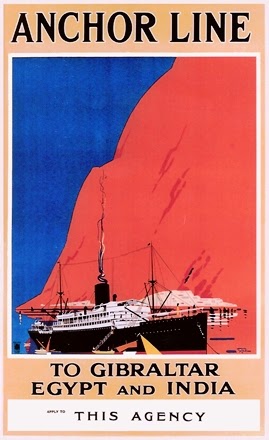
The ANCHOR LINE Indian Run

Bill Miller writes about the old Scottish steamship company Anchor Line, of Glasgow:
"The smell of curry!  "They were said to be the best kept, most immaculate passenger ships using the port of Liverpool in the 1950s & '60s," said Mike McDougle, who served aboard Britain's long-gone Anchor Line and aboard the Company's three, 11,000-ton passenger ships, the Caledonia, Cilicia & Circassia, which carried up to 300 one-class passengers each.   "We were on the Indian run – sailing by way of Gibraltar, Port Said and the Suez Canal to Karachi and, the final stop, to Bombay.   We carried very few tourists actually, but mostly government people, lots of the old colonials, businessmen, tea merchants and Indians including the occasional maharaja.   Those Indian princes traveled with entire entourages that occupied as many as a dozen cabins onboard.   One royal, I think it was the Maharaja of Rawalpindi, had a stateroom just for his pet falcon."
"These Anchor liners were famed for their cuisine," added Mike.   "They had all-Indian galley crews that prepared the most wonderful curries.   Just having, say, lunch aboard at Liverpool was a treat.   Anchor Line food was equal to the finest Indian restaurant.  Anchor was also noted for its exceptional maintenance and shipboard care.   Everything, even the engine room, was in pristine condition.   Even though these ships were over 20 years of age, it was as if they'd just left the shipyard."

Luís Miguel Correia end note: In Portugal the Companhia Colonial de Navegação had an unofficial link to Anchor Line in two ways: 
In 1929 CCN purchased from Anchor Line the liner ASSYRIA and as the COLONIAL she served under the Portuguese colours until sold for breaking up in 1950.
 Then at the end of WW2 an agreement between the Governments of Portugal and Great Britain gave priority to the building of merchant ships in British yards for Portuguese owners. CCN ordered two fine 13 000 grt passenger liners from John Brown of Clydebank, the PÁTRIA, delivered in December 1947 and the IMPÉRIO, delivered six months later while the rival Companhia Nacional de Navegação (CNN) ordered two passenger motor ships of similar size but of more modern design from Newcastle yards, the sisters ANGOLA and MOÇAMBIQUE. 
The CCN pair was built and delivered one years in advance of the Nacional sisters mainly because instead of designing the PÁTRIA and IMPÉRIO from scratch, original plans developed by John Brown for Anchor Line before WW2  were used and adapted to Cia. Colonial requirements. This saved a full year and in fact The Colonial sisters were very similar in terms of exterior design to the Anchor final three passenger liners.
Built for the Lisbon-East Africa passenger and mail service, the PÁTRIA and the IMPÉRIO only made one voyage each homebound by Suez, the IMPÉRIO in the 1950s and the PÁTRIA in 1962 when she sailed from Mozambique for Karachi and then home to Lisbon. 
Further to the official mail service, the Portuguese liners also cruised from time to time and also used to embark in Cape Town and Durban tourists from South Africa for the round coastal trip up to Mozambique and back, using the first class cabins alloted to passenger from Angola and left vacant after the ships sailed South from Moçamedes. 
There was always a group of South African cruise passengers aboard when the ships sailed the Indian Ocean and often there was occasion for romance between young Portuguese ship officers and S.A. pretty girls, some giving way to weddings.
Texto e imagens /Text and images copyright L.M.Correia. Favor não piratear. Respeite o meu trabalho / No piracy, please. For other posts and images, check our archive at the right column of the main page. Click on the photos to see them enlarged. Thanks for your visit and comments. Luís Miguel Correia

Saturday, June 07, 2014

CREOULA no Tejo


Lisboa, 7 de Junho de 2014: hoje foi dia de saída do lugre CREOULA para mais uma viagem de treino de mar, com a duração de 7 dias, desta vez com a Universidade Itinerante do Mar e o colégio Pedro Arrupe a bordo e a cidade de Sevilha como destino.

Acompanhámos o navio a descer o Tejo e entretanto reactivámos o BLOGUE DO CREOULA, agora com aspecto mais moderno e funcional, pelo que estão todos convidados a voltarem a visitar  o nosso espaço privativo de divulgação do CREOULA e dos seus irmãos SANTA MARIA MANUELA e ARGUS, que continuaremos a enriquecer com notícias, fotografias e histórias antigas e recentes.
Blogue do CREOULA renovado aqui...

We are pleased to inform that our site dedicated to the CREOULA and her sister SANTA MARIA MANUELA and ARGUS has just been refitted and updated with photographs, news and stories about these magnificent Portuguese sail training ships. Check the CREOULA blog here, and enjoy. Photographs taken today, 7th June 2014 in Lisbon showing CREOULA leaving the river Tagus for another cruise, this time bound for Seville, Spain.


Texto e imagens /Text and images copyright L.M.Correia. Favor não piratear. Respeite o meu trabalho / No piracy, please. For other posts and images, check our archive at the right column of the main page. Click on the photos to see them enlarged. Thanks for your visit and comments. Luís Miguel Correia 

Thursday, June 05, 2014

Ships, ships, ships...


Esta semana tem sido pródiga em navios visitados pelo Blogue dos Navios e do Mar: o SANTA MARIA MANUELA a 3 de Junho, no decorrer de uma curta escala para embarcar 50 passageiros, o HORIZON na primeira escala em Lisboa com as cores da CROISIERES DE FRANCE a 4 de Junho e hoje - 5 de Junho, o CREOULA revisitado no Alfeite. Belos navios a dar continuidade a uma vida inteira a ver navios...
This week the SHIPS AND THE SEA blog has been particularly busy visiting ships: the SANTA MARIA MANUELA on 3rd June, on a quick call to embark 50 passengers for a coastal cruise to Setúbal, the HORIZON on her maiden call to Lisbon under the livery of CROISIERES DE FRANCE on  4th June and today - 5 June, the CREOULA revisited at the Alfeite naval base. Great ships to look at, always...

Texto e imagens /Text and images copyright L.M.Correia. Favor não piratear. Respeite o meu trabalho / No piracy, please. For other posts and images, check our archive at the right column of the main page. Click on the photos to see them enlarged. Thanks for your visit and comments. Luís Miguel Correia 

A Marinha e os Arquivos


A Marinha e os Arquivos: mostra documental a não perder, em Lisboa no pavilhão central da Cordoaria, de 9 a 23 de Junho, das 10h00 às 17h00, todos os dias úteis.


Texto e imagens /Text and images copyright L.M.Correia. Favor não piratear. Respeite o meu trabalho / No piracy, please. For other posts and images, check our archive at the right column of the main page. Click on the photos to see them enlarged. Thanks for your visit and comments. Luís Miguel Correia

Bill Miller lecturing on the QUEEN VICTORIA

Tuesday, June 3rd At sea: Cool breezes on the starboard side! Interesting diversion & added treat as Cmdr Rynd narrates a morning sail with the QUEEN VICTORIA hugging the Cornish coast and noting at least half a dozen lighthouses – with evocative names like Lizard, Wolf Rock and Eddystone. 
Off to sea! John Jones was a mere boy of fifteen when he walked into the huge and very grand Cunard Building in his native Liverpool. "A man that seemed to be 10 ft tall took me to a room, placed me against a wall and measured my height. Happily, I was just tall enough," recalled John. "I was soon off to training school and then assigned to the SCYTHIA, then 30 years old and sailing on the Liverpool to Quebec City run. I earned 7 pounds a month or 5p an hour. I was given a crimson uniform and pillbox hat and off I went. After that, I had to buy my own uniforms from a London tailor on Saville Row. We were said to be the youngest seamen in the British merchant navy and, as a group, we slept 10-12 to a room. We ran errands onboard, delivered telegrams and other messages, helped in the purser's office and sometimes sat and chatted with passengers, especially ladies in first class, who were traveling alone. One grand lady once had 4 bellboys sitting at her feet!"
John was soon posted to another veteran Cunarder, the FRANCONIA. "She went aground in the St Lawrence, near Quebec City [July 1950], and then needed weeks of repairs. Many of the crew took jobs in the Chateau Frontenac Hotel to stay busy, but mostly to earn extra money."
Afterward, John became what he called a "gypsy". He served with Canadian Pacific, aboard the EMPRESS OF CANADA & EMPRESS OF FRANCE, with Pacific Steam Navigation and their REINA DEL PACIFICO & REINA DEL MAR, on the troopship EMPIRE CLYDE and on the migrant ship GEORGIC. "While with Cunard, I was something of one of those 'Cunard Yanks,' bringing home clothes, food and records from New York. We'd all go to Macy's and Woolworths. We also went to the Market Diner on 12th Avenue & 52nd Street and where the third drink was always free for seamen. We had lots of colonial-type passengers on the West Coast of South America run of the REINA DEL PACIFICO & REINA DEL MAR plus lots of businessmen. It was still three-class and I recall that first class was really too quiet, even too dull, and so these rich, well-dressed passengers would often march down to more casual, fun-filled tourist class in the evenings. Aboard the Empire Clyde, we carried troops, guns and military equipment for the planned British invasion of Egypt in 1956. And as for theGeorgic, which still had damages from being bombed and set afire in the War, she was said to be the 'roughest' passenger ship in the entire British fleet. She was really not fit for regular passenger service. Regular Cunard crews did not want to sail aboard her and sometimes there were too few crew. It was said that Cunard would go to prisons in and around Liverpool and gather-up minor criminals to serve onboard. These crew members were known to cause problems such as brawls and problems with the police in ports of call. They once called a sudden strike in Cape Town and would not re-board the ship, and at another time the ship itself was actually banned from Australian ports. When I served aboard the GEORGIC, we carried 10 pound Poms, those British migrants out to Sydney. Then we sailed up to Malaya, carrying Australian troops. Then it was to Viet-Nam and a charter to the French. We carried troops and evacuees out of troubled French Indo-China. The troops were a rough lot that included wounded, diseased and some hired Africans. We delivered them on a long, hot voyage to Algiers and then to Marseilles."
John was also posted to another Cunarder, the freighter ALSATIA, which was on the London-New York run. "We went, in the dark of a late night, to the rescue of the sinking American freighter FLYING ENTERPRISE. She was foundering off the British coast. We were ready with blankets, medicines and lots of hot soup."
John was soon back to passenger ships by the mid 1950s, however. He continued to be that "gypsy" and sailed aboard Shaw Savill Line, Union-Castle, New Zealand Shipping Company and the exotic Booth Line. At Shaw Savill, he sailed in two of the Company's oldest if smaller liners. "The MATAROA & TAMAROA, used on the long New Zealand run, were two of the oldest and slowest passenger ships in the British fleet by then," he recalled. "It took six weeks to go from London to Auckland via Curacao and the Panama Canal. Occasionally, we'd stop at Pitcairn Island to land supplies and mail. The locals, who were expert rowers, would come out to the anchored ship in open boats. They were very spiritual people. Once, these open boats were caught in a fierce, tropical storm. They all continued to row as they sang hymns. After arriving in New Zealand, we'd stay in local ports for six weeks, mostly loading lamb to be brought back to England. I made extra money by working as a temporary docker. But once I missed the ship and was taken to jail as a deserter. The jail for 2 nights was awful – a straw mattress for a bed and meager rations for food. After I was freed, I was flown – and under police guard -- to the South Island to rejoin the MATAROA. I was taken aboard, brought before the captain and fined a week's pay plus the cost for the jail, police and plane ride. I returned to London with no money – not a penny!"
John also served aboard Union-Castle's BLOEMFONTEIN CASTLE, an all-tourist class ship designed purposely for immigrants and low-fare travelers. "We carried lots of British migrants going out to Rhodesia, but also stopped in Rotterdam and collected Dutch & German migrants as well. Often, they were very poor people. When we'd reach Africa, on their last day onboard, they'd steal food from the dining room. They had no money for food for even their first days ashore."
Aboard London-based New Zealand Shipping Company, John served on the 21,000-ton RANGITOTO, which carried over 400 passengers in all one-class quarters. "NZ Shipping, as it was called, was said to be a cut above Shaw Savill," he remembered. "Their ships were faster and more comfortable."
The Booth Line, also British, maintained an unusual service – across the mid Atlantic from Liverpool to the Caribbean and then 1,000 miles up to the Amazon River to Manaus. He sailed aboard that Company's passenger ships: the HILARY, HILDEBRAND & HUBERT. "These voyages along the Amazon were hot, steamy, thickly humid. The crew would often sleep on deck. Below, if you opened a porthole, insects of all sizes and types would come flooding in! The ships' navigating officers had to be very careful because of submerged rocks and floating logs in the River. Once, we bent the ship's only screw and then limped to Manaus. There was no shipyard in such a remote place and so two Brazilian divers were hired to make repairs. They carved away some of the twisted steel but which actually made the ship faster than before. The chief engineer was more than surprised – and pleased! We carried businessmen, traders and sometimes even a few tourists in first class and missionaries, medical people and teachers in tourist class. The crew often bought parrots and birds in Manaus and then brought them home to Liverpool. Myself, I bought a little Cayman, kept it in my cabin, but then discovered it didn't like colder climates. Soon after landing in Liverpool, I gave it to the Chester Zoo. Liverpool customs were easy in those days. Give them a few pounds and almost anything could be brought in!"
By the early 1960s, John was to go to another passenger ship, the APAPA of Elder Dempster Lines and serving on the Liverpool-West Africa run, but was hired – and almost at the last minute – by Lockheed Aircraft's Liverpool plant. "I was sent for training and became a skilled craftsman – making precision aircraft parts. My life as a seamen – of working 10 hours a day and 90 hours a week – was wonderful, a great education in itself, but it was then over."
Pass the salt! Dinner tonight with Ronnie Keir, a longtime Cunard friend & Chief Engineer of the QUEEN VICTORIA. Expectedly, he has huge knowledge about liners & has a great regard and interest in ships of the past. And being from Scotland, he has special interest in ships & shipbuilding on the historic River Clyde.
Photo: The RANGITOTO, one of New Zealand Shipping's big, 21,000-ton combo passenger-cargo liners, seen at Melbourne.
Texto e imagens /Text and images copyright Bill Miller (Edited by L.M.Correia). Favor não piratear. Respeite o meu trabalho / No piracy, please. For other posts and images, check our archive at the right column of the main page. Click on the photos to see them enlarged. Thanks for your visit and comments. Luís Miguel Correia

Wednesday, June 04, 2014

DAPHNE em Alang


O navio de passageiros DAPHNE ex-PRINCESS DAPHNE já está fundeado próximo de Alang, a aguardar uma ultima inspecção antes da atribuição de um local para encalhar a fim de ser desmantelado. Chegou a Alang ao amanhecer de 2 de Junho depois de uma última viagem sem regresso, desde Creta, onde estivera imobilizado desde Outubro de 2012 na sequência do colapso da companhia Classic International Cruises. 
Os mapas com a localização do DAPHNE são reproduzidos do "AIS MARINE TRAFFIC".
Alang é o principal cemitério de navios da actualidade e fica localizado próximo de Damão e Diu, que com Goa e alguns pequenos enclaves constituíam o Estado Português da India, tomado pela força em Dezembro de 1961. 
Texto e imagens /Text and images copyright L.M.Correia. Favor não piratear. Respeite o meu trabalho / No piracy, please. For other posts and images, check our archive at the right column of the main page. Click on the photos to see them enlarged. Thanks for your visit and comments. Luís Miguel Correia 

Friday, May 30, 2014

BERLIN e CREOULA no Tejo


O navio de cruzeiros BERLIN e o navio de treino de mar CREOULA fotografados na tarde de 30 de Maio de 2014 no Tejo, com o primeiro a preparar-se para alcançar o segundo...

Texto e imagens /Text and images copyright L.M.Correia. Favor não piratear. Respeite o meu trabalho / No piracy, please. For other posts and images, check our archive at the right column of the main page. Click on the photos to see them enlarged. Thanks for your visit and comments. Luís Miguel Correia

Thursday, May 29, 2014

LAGOA e EUROPA 2


Na manhã de Sábado, 25 de Maio de 2014, entraram diversos navios em Lisboa, caso do EUROPA 2 e do LAGOA, que subiram o Tejo muito próximos, embora com resoluções diferentes: o LAGOA apressado para atracar, o EUROPA 2 contemplativo para que os seus passageiros absorvessem a beleza mágica da cidade de Lisboa vista a partir do rio...

Texto e imagens /Text and images copyright L.M.Correia. Favor não piratear. Respeite o meu trabalho / No piracy, please. For other posts and images, check our archive at the right column of the main page. Click on the photos to see them enlarged. Thanks for your visit and comments. Luís Miguel Correia

Largar com saudades de Lisboa


Os navios de cruzeiros gostam de Lisboa. A cidade é bonita, o porto civilizado e as gentes simpáticas. Alguns parece não quererem ir embora: é o caso do ASUKA II que tem vindo ao Tejo anualmente com turistas japoneses em viagens à volta do mundo. Costuma ficar de um dia para o outro. Deixou marca no cais de Santa Apolónia: 2013, 2014, e veremos se volta em 2015...

Texto e imagens /Text and images copyright L.M.Correia. Favor não piratear. Respeite o meu trabalho / No piracy, please. For other posts and images, check our archive at the right column of the main page. Click on the photos to see them enlarged. Thanks for your visit and comments. Luís Miguel Correia

Largam quase em silêncio...


A visita está a acabar, a prancha já foi retirada, os amarradores estão a postos para largarem os cabos, o navio vai partir dentro de breves instantes. 

Não há ninguém a dizer adeus, nada de despedidas, vamos ali mas estaremos de volta depressa. Parecem partidas a fingir, estas dos navios de cruzeiros dos cais de Lisboa. 
Antigamente chorava-se, acenava-se, gastava-se a vista num derradeiro abraço impossível. Em Alcântara ou na Rocha, havia dias em que os nossos paquetes, apelidados de Transportes se enchiam de gente fardada de verde, e valia tudo entre o "Adeus e até ao meu regresso" - subiam aos mastros, saltavam para as baleeiras, enchiam-se todos os espaços exteriores do NIASSA, do VERA CRUZ...
Hoje não, é tudo demasiado civilizado e asséptico. Mas podia ser de outra maneira se o Porto de Lisboa apadrinhasse o faz de conta com umas gentes a carpirem a partida acenando e enchendo o vazio do momento da partida. Podiam ser funcionários a precisarem de boa nota na avaliação, ou entusiastas de navios sem vedações a proteger de entusiasmos excessivos. Que belas partidas seriam. 
No dia 26 de Maio o EUROPA 2 largou, apitou, mas ninguém retribuiu o cumprimento de despedida. Tempos modernos.
Texto e imagens /Text and images copyright L.M.Correia. Favor não piratear. Respeite o meu trabalho / No piracy, please. For other posts and images, check our archive at the right column of the main page. Click on the photos to see them enlarged. Thanks for your visit and comments. Luís Miguel Correia 

Espelho meu...


Espelho, espelho meu, há algum porto mais bonito do que o meu?

Talvez sim, mas não serão muitos...

Em Lisboa, a cidade embrenha a sua imagem de fado e mar no costado dos navios que a visitam a tentar largar também, ao fim do dia, para qualquer destino além Tejo: pode ser Cádis, ou Leixões, ou Vigo, ou Casablanca, ou Málaga, ou Funchal, ou Barcelona.

Por mim até podia ser Cascais...

O reflexo do panteão na janela do EUROPA 2 faz acreditar na inquietitude permanente de Santa Apolónia, de Santa Engrácia...
E no final do dia lá vão os navios barra fora, e ao cais atraca uma tranquilidade vazia de paisagem com vista reduzida.

Mas a vida renova-se depressa, provavelmente na manhã seguinte, já lá estará outro navio com uma chaminé de outra cor e mais turistas descobridores de Lisboa...

Texto e imagens /Text and images copyright L.M.Correia. Favor não piratear. Respeite o meu trabalho / No piracy, please. For other posts and images, check our archive at the right column of the main page. Click on the photos to see them enlarged. Thanks for your visit and comments. Luís Miguel Correia

The cruise ship and the tug


EUROPA 2 leaving Lisbon's Santa Apolónia cruise terminal on 26 May 2014: the local tug AJAX looks quite small, just like in the old days images depicting large passenger liners and very small tenders and tugs at their bows in a much smaller scale...

Texto e imagens /Text and images copyright L.M.Correia. Favor não piratear. Respeite o meu trabalho / No piracy, please. For other posts and images, check our archive at the right column of the main page. Click on the photos to see them enlarged. Thanks for your visit and comments. Luís Miguel Correia

Tentações de Santa Apolónia...

É uma tentação permanente, daquelas que nos deixam a alma inquieta pelo olhar e a imaginação de como seria...

Passar por Santa Apolónia e ver estas criaturas provocadoras, ainda por cima com solicitações à partida na porta do terminal é sempre um passo para realçar esta nossa vida de provações. Não que não viaje muitas vezes em navios destes, mas nunca é tanto quanto o necessário para o sossego do espírito não perturbar a fluência rotineira dos sentidos...

Esta Segunda-feira, 26 de Maio o EUROPA 2 convidava à largada barra fora de forma verdadeiramente provocadora...
O que é que se há-de fazer?

Um caso para ter efectivamente paciência...

Texto e imagens /Text and images copyright L.M.Correia. Favor não piratear. Respeite o meu trabalho / No piracy, please. For other posts and images, check our archive at the right column of the main page. Click on the photos to see them enlarged. Thanks for your visit and comments. Luís Miguel Correia


Tuesday, May 27, 2014

Ships and the sea face...


This is a place for ships and the sea as seen by Luís Miguel Correia, but there is more than the usual stuff: after some pictures of EUROPA 2 and SEVEN SEAS VOYAGER I met this original cat in Lisbon...

Texto e imagens /Text and images copyright L.M.Correia. Favor não piratear. Respeite o meu trabalho / No piracy, please. For other posts and images, check our archive at the right column of the main page. Click on the photos to see them enlarged. Thanks for your visit and comments. Luís Miguel Correia

EUROPA 2: um paquete alemão globalizado


Imagens do paquete EUROPA 2, da companhia alemã Hapag-Lloyd, em Lisboa a 26 de Maio de 2014. O mundo dos navios já não é o que era, com todas as bagunças e globalidades deste século XXI. As bandeiras perderam o seu significado e agora são quando muito troféus para a rapaziada dos marquetingues, espécie de feiticeiros futuristas especialistas na venda de quimeras várias, em adoração permanente dos bezerros de oiro actuais, que é como quem diz, é preciso é fazer dinheiro, mais, muito dinheiro.
Este EUROPA século XXI está carregado de toques de marquetingueiros: para começar o nome é pouco feliz, não exactamente o nome , mais o númeral que se lhe segue. Este navio é o quarto EUROPA da companhia Hapag-Lloyd e tive oportunidade de fotografar e visitar todos. Os dois primeiros eram os mais genuínos, registados em Bremen, que os paquetes alemães com o nome EUROPA têm raízes em Bremen, na frota da companhia Norddeutscher Lloyd Bremen (NDL), com destaque para o EUROPA de 1930, mais tarde LIBERTÉ da companhia CGT. Em 1970 a NDL fundiu-se com a Hapag, antiga rival de Hamburgo que entretanto praticamente abdicara de ter navios de passageiros, com excepção dos navios mistos da carreira do Oriente e, por pouco tempo, do navio de cruzeiros ARIADNE ex-PATRICIA. 
Em 1970 os dois paquetes do NDL, o EUROPA de 1965 e o BREMEN de 1959 integraram a frota conjunta, mas a administração dos serviços de passageiros e cruzeiros manteve a sede em Bremen. Só foram instalados no final dos anos 1990 em Hamburgo. Este EUROPA novo devia ser assim o EUROPA 4, pelo menos, pois houve outros homónimos anteriores. Depois, o escudo e a bandeira da cidade de Hamburgo à proa não fazem sentido uma vez que o registo do EUROPA 2 é em Malta, cuja bandeira flutua à poupa. Os navios mercantes alemães, tal como os portugueses, têm por tradição içar a bandeira da cidade do porto de registo à proa. O único paquete verdadeiramente alemão em termos de bandeira e registo é o DEUTSCHLAND, cujo armador está mortinho por o transferir para as Bahamas ou Malta.
Trapalhices formais à parte, o EUROPA2 é um dos melhores navios de passageiros da actualidade, seguindo a tradição do EUROPA de 1999 e dos anteriores. Pena que a bandeira já não seja alemã, mas isso, os próprios QUEENs já deixaram de ser verdadeiramente britânicos, o registo é das Bermudas e quase se não dá pela diferença, acabou-se foi o títulos do QM2 que deixou de ser um "R.M.S" -Royal Mail Ship.) 
Observações à parte, foi bom rever esta belo paquete EUROPA 2...
Texto e imagens /Text and images copyright L.M.Correia. Favor não piratear. Respeite o meu trabalho / No piracy, please. For other posts and images, check our archive at the right column of the main page. Click on the photos to see them enlarged. Thanks for your visit and comments. Luís Miguel Correia