Tuesday, May 20, 2014

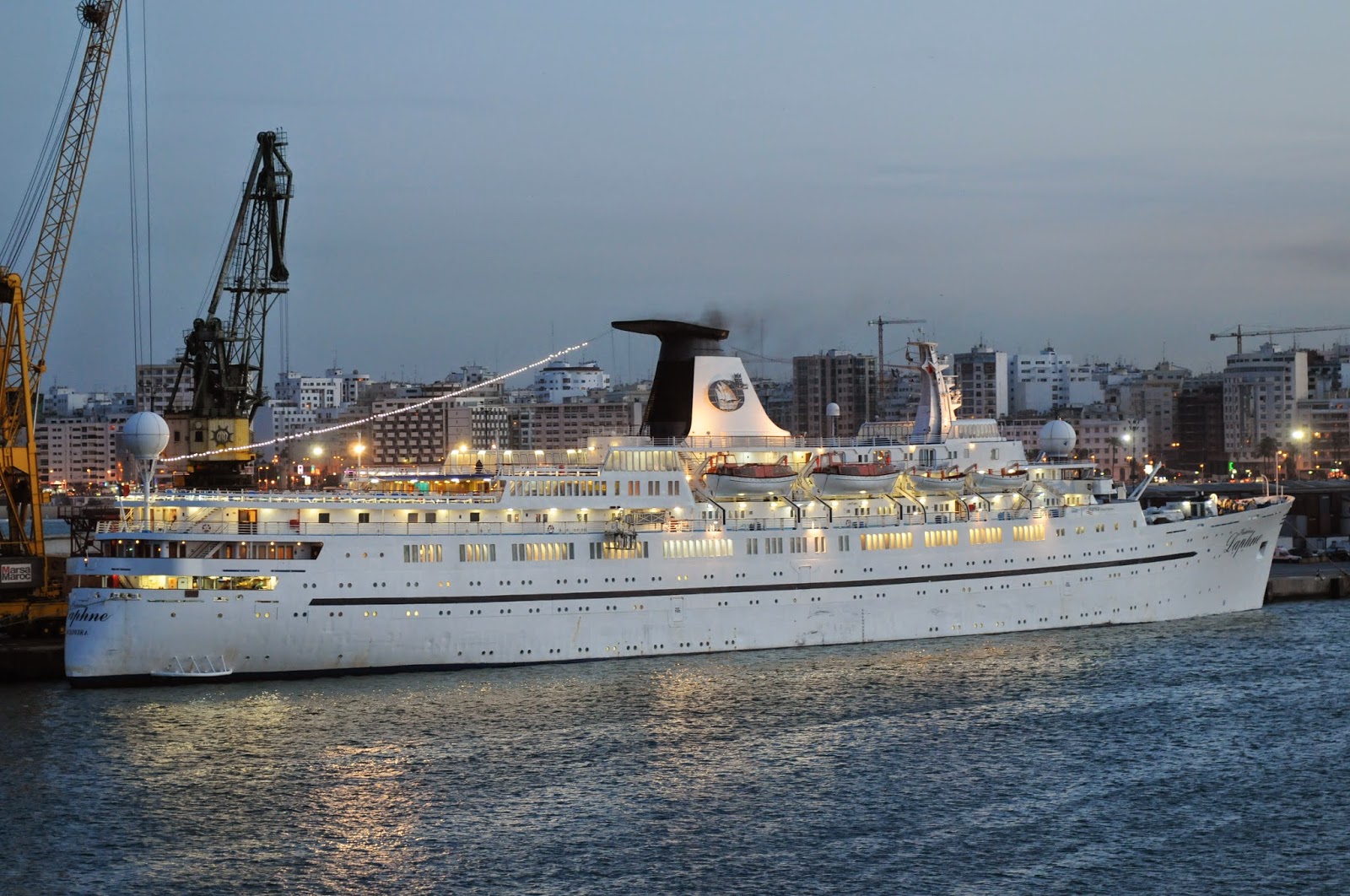
PRINCESS DAPHNE leaving Malaga

The PRINCESS DAPHNE sailing from Malaga on 15 September 2010 cruising in the Mediterranean on charter to Hansa Cruises of Germany.
Texto e imagens /Text and images copyright L.M.Correia. Favor não piratear. Respeite o meu trabalho / No piracy, please. For other posts and images, check our archive at the right column of the main page. Click on the photos to see them enlarged. Thanks for your visit and comments. Luís Miguel Correia 

A close look into PRINCESS DAPHNE

On 15 September 2010 I did some nice photographs of PRINCESS DAPHNE berthed in Malaga, Spain. DAPHNE and her sister DANAE are a perfect blend of classic British hull design of mid 20th century and scandinavian of passenger ship design of the 1970s. 
They have the last surviving cruiser sterns and when rebuilt in Greece they became upmarket luxury cruise ships, looking for the same kind of passenger cruising on the Royal Viking Line sisters...
Berthed at Malaga cruising for the German market all looked fine for the old girl recently reunited to her sister DANAE. She did run out of luck in 2012, and now DAPHNE is dooing her final crossing of the Suez Canal. Like in the old times of Port Line...


Texto e imagens /Text and images copyright L.M.Correia. Favor não piratear. Respeite o meu trabalho / No piracy, please. For other posts and images, check our archive at the right column of the main page. Click on the photos to see them enlarged. Thanks for your visit and comments. Luís Miguel Correia

HABIB underway off Tunis


A very interesting passenger RoRo ferry, the Tunisian HABIB photographed underway off the port of La Goullete, Tunis, on 17 September 2010.

The HABIB was built in 1977-78 in Rendsburg, Germany for Tunisia and still has a look of elegance now missing on many more modern passenger ferries.
Texto e imagens /Text and images copyright L.M.Correia. Favor não piratear. Respeite o meu trabalho / No piracy, please. For other posts and images, check our archive at the right column of the main page. Click on the photos to see them enlarged. Thanks for your visit and comments. Luís Miguel Correia

Sunday, May 18, 2014

DAPHNE a caminho da sucata

O navio de cruzeiros PRINCESS DAPHNE, último navio de passageiros ligado ao ramo lisboeta da Família Potamianos, largou ontem, dia 17 de Maio de 2014, de Souda Bay, na ilha de Creta, com destino a Port Said e a sucata no subcontinente indiano. 
O navio estava imobilizado em Creta desde Outubro de 2012, quando a frota da Classic International Cruises foi arrestada em diversos portos do Mediterraneo.
O navio mudou de bandeira, de Portugal para Kitts e Nevis e voltou a chamar-se DAPNHE propositadamente para esta derradeira viagem sem regresso. Foi construido em Newcastle em 1955 para a companhia Port Line com o nome PORT SYDNEY e reconstruído na Grécia em 1973-75. Integrou a frota da Classic International Cruises em 2008, tendo sido o último navio comprado por Georgios Potamianos, que faleceu em Maio de 2012. A sua empresa e os seus últimos cinco navios não sobreviveram por muitomais  tempo, como acontece tantas vezes com armadores gregos: a geração seguinte não consegue dar continuidade à obra do fundador, e a Classic International Cruises não teve destino diferente. Fotografia do DAPHNE tirada de bordo do ATHENA em Tanger a 14 de Setembro de 2010, quando os dois navios navegaram em cruzeiros fazendo escalas consecutivas nos mesmos portos durante diversos dias.
O  Texto e imagens /Text and images copyright L.M.Correia. Favor não piratear. Respeite o meu trabalho / No piracy, please. For other posts and images, check our archive at the right column of the main page. Click on the photos to see them enlarged. Thanks for your visit and comments. Luís Miguel Correia

PRINCESS DAPHNE on her way to the beach...


PRINCESS DAPHNE, the final cruise ship under control of the Lisbon branch of the Potamianos Family, sailed yesterday, 17 May 2014, from Souda Bay, in the island of Crete, bound for Port Said and the beaches of Alang, the India final destination for so many ships. 
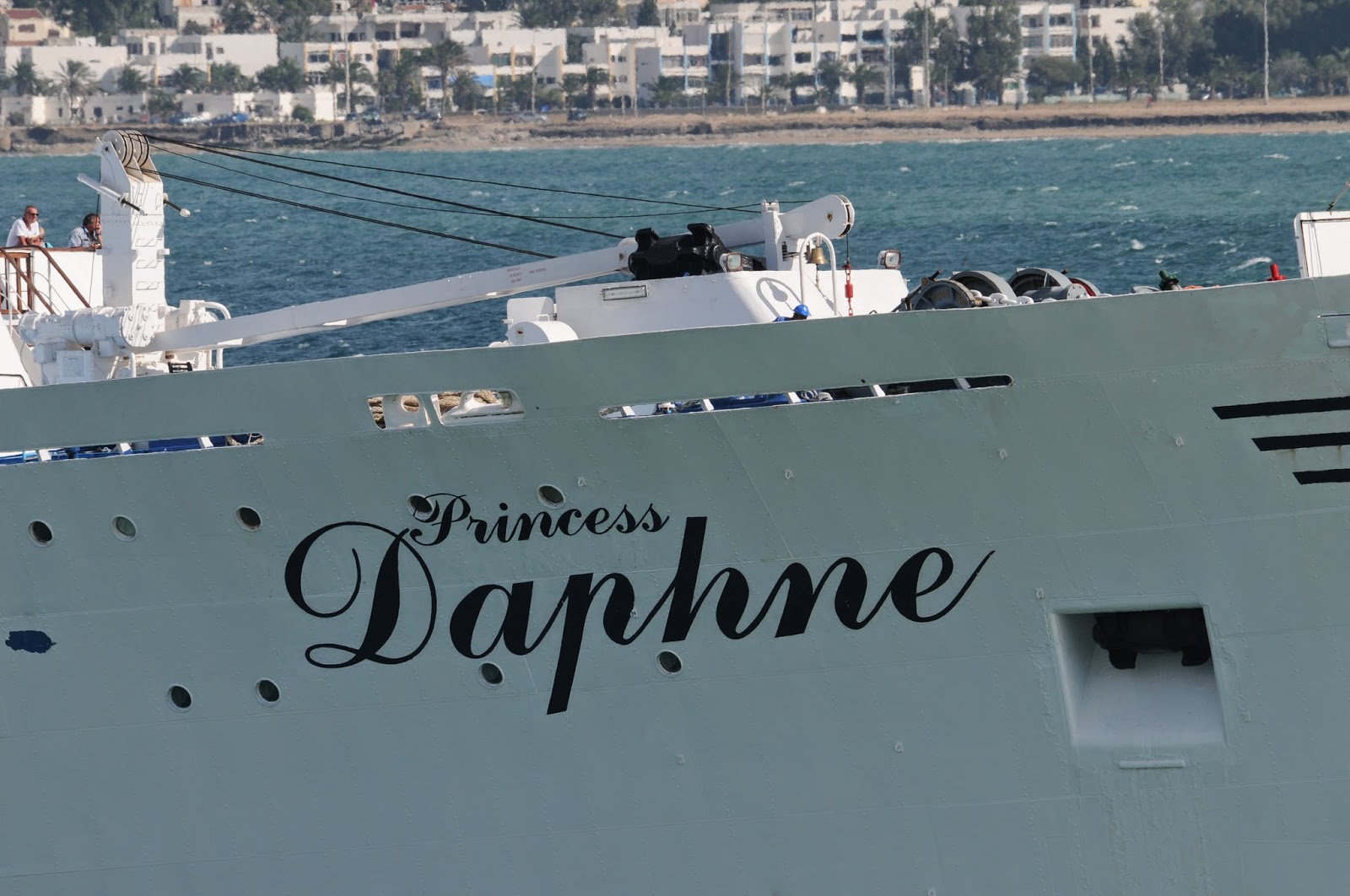
For this final "cruise" she was renamed DAPHNE and now sails under the Kitts and Nevis flag. As PRINCESS DAPHNE this classic beautiful ship had been laying at Souda Bay since October 2012 when four Classic International Cruises ships still operating at the time, were arrested in the Mediterranean.
PRINCESS DAPHNE was the last cruise ship purchased by the late Georgios Petros Potamianos, founder of Lisbon-based Classic International Cruises, an organization developed following the purchase of the FUNCHALin August 1985 from Portuguese state owned company CTM - Companhia Portuguesa de Transportes Marítimos.
Georgios Potamianos operated six classic passenger liners and cruise ships from Lisbon, the largest being the VASCO DA GAMA. Over the years he was able to become a successful independent operator of classic older passenger ship tonnage. However Mr. Potamianos passed away in May 2012 and like so many other Greek shipping concerns his heritage did not survive for long. 
Early in 2013 Georgios Potamianos sons reached an agreement with a Lisbon bank and retained ownership of the PRINCESS DAPHNE, while the bank sold the other remaining ships to Portuscale Cruises. Unfortunately they were unable to return this ship to commercial cruise service despite some efforts, and so DAPHNE has just been sold for scrap.
PRINCESS DAPHNE was built in 1955 in Newcastle for Port Line as PORT SYDNEY. She was sold in 1972 to J. C. Karras and rebuilt as a luxury cruise ship, returning to service in 1975.
Photos of the PRINCESS DAPHNE taken in Tangiers on 14 September 2010 by Luís Miguel Correia from fleetmate ATHENA. Bth ships were cruising in tandem for several days...
Texto e imagens /Text and images copyright L.M.Correia. Favor não piratear. Respeite o meu trabalho / No piracy, please. For other posts and images, check our archive at the right column of the main page. Click on the photos to see them enlarged. Thanks for your visit and comments. Luís Miguel Correia

SATURNIA and VULCANIA in post cards

Of all the magnificent Italian transatlantic passenger liners of the twentieth century, I would say the motor sisterships SATURNIA and VULCANIA were by far the more sucessful.
When built in the late 1920s they were the largest and fastest passenger motorships in the world. 
Both were constructed in the Adriatic for the famous Triestre based Cosulich Line, and they were followed by two smaller sisters with similar magical names, the NEPTUNIA and OCEANIA, but this later more modern pair did not get the same luck as the previous pair, and both were torpedoed on the same day (18 September 1941) in the Mediterranean by a British submarine (HMS UPHOLDER) during World War Two.
SATURNIA and VULCANIA joinned the Italian Line fleet in 1937 but remained based in Trieste until the end of their Italian days in 1965 when both were replaced by the famous sisters MICHELANGELO and RAFFAELLO, the final North Atlantic twins to enter service, in 1965, and too late actually as they only lasted for 10 years in active service.
Of the North American service, SATURNIA and VULCANIA were also the Italian Line ships more frequently seen in the Portuguese ports, mainly Lisbon and Ponta Delgada.
They survived the WW2 that proved fatal to most other great Italian Line passenger ships and had another two decades of regular service becoming the late grand old ladies of the Mediterranean -New York service. 
SATURNIA was scrapped in Italy in 1965 but sister VULCANIA had a reprieve and was sold by Italia to Siosa Line and sailed as CARIBIA until September 1972 and was broken up in Taiwan in 1974. I remember very well both ships in Lisbon, they were quite a sight.
Texto e imagens /Text and images copyright L.M.Correia. Favor não piratear. Respeite o meu trabalho / No piracy, please. For other posts and images, check our archive at the right column of the main page. Click on the photos to see them enlarged. Thanks for your visit and comments. Luís Miguel Correia

Saturday, May 17, 2014

REX: Italian Line flagship

Two original post cards of the former italian Line flagship REX, one of the most famous passenger liners of the 20th century and the only Italian liner to hold the Blue Riband trophy for the speed record on the North Atlantic crossings.
Texto e imagens /Text and images copyright L.M.Correia. Favor não piratear. Respeite o meu trabalho / No piracy, please. For other posts and images, check our archive at the right column of the main page. Click on the photos to see them enlarged. Thanks for your visit and comments. Luís Miguel Correia

Thursday, May 15, 2014

PONTA da BARCA e ESPÍRITO SANTO


Navios de carga açorianos PONTA DA BARCA e ESPÍRITO SANTO, da empresa Transportes Marítimos Graciosenses atracados no porto da Praia da Vitória a 11 de Setembro de 2013.


Estes navios são utilizados no transporte de carga geral e cimento nas ilhas do Grupo Central, no Arquipélago dos Açores e são navios de origem norueguesa, comprados em segunda mão.

Trata-se de pequenos navios de carga , já com bastantes anos de serviço em águas nórdicas e do Atlântico Norte, que é afinal esse mar dos Açores, grandioso e imponente.
Este cais privativo dos TMG na Praia da Vitória faz relembrar o ambiente marítimo de outras docas, outros navios em outras épocas, no tempo da carga geral...
Texto e imagens /Text and images copyright L.M.Correia. Favor não piratear. Respeite o meu trabalho / No piracy, please. For other posts and images, check our archive at the right column of the main page. Click on the photos to see them enlarged. Thanks for your visit and comments. Luís Miguel Correia

N/M CECÍLIA A no Faial


Navio de carga costeiro CECÍLIA A atracado no porto da Horta e a navegar no Canal do Pico a 10 de Setembro de 2013.

Para além da majestade atlântica de toda a envolvência marítima e oceanica das ilhas dos Açores, a paisagem surpreende pela diversidade de embarcações e navios em navegação e nos portos, caso do CECÍLIA A, cujo armador fez reviver as cores da antiga Empresa Insulana de Navegação nos seus navios: a memória e a nostalgia projectando-se na actualidade...

Evidente também o "pedigree" escandinavo do CECÍLIA A, como acontece com os cargueiros da Sociedade de Transportes Marítimos Graciosenses...

Texto e imagens /Text and images copyright L.M.Correia. Favor não piratear. Respeite o meu trabalho / No piracy, please. For other posts and images, check our archive at the right column of the main page. Click on the photos to see them enlarged. Thanks for your visit and comments. Luís Miguel Correia

AÇORES na Praia da Vitória


No último quartel do século XX a frota de navios de pesca dos Açores sofreu um incremento importante, com a construção de numerosas unidades saídas do estaleiro Marimar, de Santo Amaro, na Ilha do Pico, caso do AÇORES, que fotografámos a 11 de Setembro de 2013 em seco na Praia da Vitória, semi-desmantelado.
Apesar da degradação física do abandono e destruição, são patentes nestas fotos do infeliz AÇORES, as linhas elegantes do casco, de madeira, revelando uma arte em vias de desaparecer, mesmo nos Açores.
O navio de pesca AÇORES foi construído em 1987 e acabado em Novembro desse ano, sendo então propriedade do armador Gregório Ferreira da Silva com registo na Horta. Com 156 toneladas de arqueação bruta e 30,70 metros de comprimento de fora-a-fora o AÇORES estava equipado com uma máquina principal Diesel Cummins de 497 kW, atingindo a velocidade de 11 nós.

Texto e imagens /Text and images copyright L.M.Correia. Favor não piratear. Respeite o meu trabalho / No piracy, please. For other posts and images, check our archive at the right column of the main page. Click on the photos to see them enlarged. Thanks for your visit and comments. Luís Miguel Correia 

Wednesday, May 14, 2014

MADEIRENSE 3 na Praia da Vitória


Um dos aspectos mais interessantes das viagens marítimas que tanto aprecio fazer prende-se com a actividade cénica portuária vista e registada por dentro, nos terminais, de bordo dos navios, de uma lancha de pilotos...

Em Setembro de 2013 tive oportunidade de voltar aos Açores a bordo de um porta-contentores em serviço regular entre o Continente e as Ilhas, e um dos portos de escala foi o da Praia da Vitória, na Ilha Terceira.
Uma das empresas que operam para os Açores é a Box Lines, inicialmente constituida pelo Grupo Sonae e posteriormente adquirida pelo Grupo Sousa, do Funchal.
Coinsequência dessa mudança de propriedade da Box Lines, o navio MADEIRENSE 3 foi transferido da Empresa de Navegação Madeirense para a Box Lines, registado em Malta e passou a navegar na carreira dos Açores.


As fotografias deste apontamento foram efectuadas durante a operação d edescarga do MADEIRENSE 3
na Praia da Vitória em Setembro de 2013.


Text and images copyright L.M.Correia. Favor não piratear. Respeite o meu trabalho / No piracy, please. For other posts and images, check our archive at the right column of the main page. Click on the photos to see them enlarged. Thanks for your visit and comments. Luís Miguel Correia

EXPRESS SANTORINI arriving at Ponta Delgada


The Greek classic passenger ferry EXPRESS SANTORINI arriving in Ponta Delgada, St. Michael's Island while operating on the Azores inter-islands service under charter to Atlântico Line on 13 September 2013. 
On the second image the container ship CORVO and the Danish sail training three masted ship DANMARK can be seen at their berthes...

Texto e imagens /Text and images copyright L.M.Correia. Favor não piratear. Respeite o meu trabalho / No piracy, please. For other posts and images, check our archive at the right column of the main page. Click on the photos to see them enlarged. Thanks for your visit and comments. Luís Miguel Correia

Escalas de navios de passageiros em Lisboa


O Porto de Lisboa continua a receber alguns dos mais bonitos e atraentes navios de passageiros do mundo nas suas viagens de cruzeiros, confirmando que o Tejo é cada vez mais uma passagem obrigatória nas rotas dos cruzeiros internacionais.

De 13 a 23 de Maio passam por Lisboa mais 16 navios de cruzeiros, destacando-se o ADVENTURE OF THE SEAS como o maior destes navios, o LOUIS AURA, que faz a primeira escala com o nome actual e ainda quatro navios da companhia italiana Costa, dois dos quais, o COSTA DELIZIOSA e o COSTA NEOROMANTICA, vão estar atracados juntos em Santa Apolónia na próxima Sexta-feira, dia 16.
Aproveitem estes dias maravilhosos de primavera para fazerem fotografias ou simplesmente passarem momentos agradáveis "a ver navios" e a sonhar com cruzeiros.
Fotografia do MSC OPERA tirada a 13 de Maio de 2014 em Santa Apolónia por Luís Miguel Correia.
Texto e imagens /Text and images copyright L.M.Correia. Favor não piratear. Respeite o meu trabalho / No piracy, please. For other posts and images, check our archive at the right column of the main page. Click on the photos to see them enlarged. Thanks for your visit and comments. Luís Miguel Correia

Monday, May 12, 2014

QUEEN MARY 2 com bandeira azul

Os mais observadores de entre de entre os espectadores à chegada e saída dos QUEENS em Lisboa no dia 6 de Maio terão reparado que embora os três navios estejam todos registados em Hamilton (Bermuda), um dos muitos segundos registos britânicos, os QUEENs de origem italiana tinham içada bandeira vermelha (Red Duster) tradicional da Marinha Mercante inglesa, enquanto o QUEEN MARY 2 hasteava a bandeira azul - o "Blue Ensign", como mostro nas fotografias de pormenor do QM2.


A razão desta diversidade cromática das bandeiras prende-se com o facto de o Comandante do QM2, no dia da passagem por Lisboa, ser oficial da Reserva Naval britânica e como tal ter direito a usar a bandeira azul. 
Os navios ingleses podem navegar com três bandeiras de cores diferentes: a branca, reservada aos navios da Marinha de Guerra - a Royal Navy, a encarnada, conhecida como "Red Duster", utilizada pela generalidade dos navios mercantes e a azul "Blue Ensign", hasteada nos navios mercantes cujos comandantes sejam oficiais da reserva naval.
A origem das três bandeiras leva-nos à história marítima britânica nos séculos XVI e XVII, quando os ingleses se tornaram uma potência marítima a seguir aos portugueses. Nessa época havia três esquadras, cada uma com a sua bandeira de cor diferente. No século XIX deu-se a atribuição actual do significado de cada bandeira. Apesar das tradições tenho algumas dúvidas se, estando os navios actualmente registados nas Bermudas, essencialmente para redução de custos salariais aos tripulantes, se manterá o direito ao uso da bandeira azul...
Texto e imagens /Text and images copyright L.M.Correia. Favor não piratear. Respeite o meu trabalho / No piracy, please. For other posts and images, check our archive at the right column of the main page. Click on the photos to see them enlarged. Thanks for your visit and comments. Luís Miguel Correia

OS QUEENS e a SVITZER

Na passada Terça-feira 6 de Maio, a empresa SVITZER destacou-se na festa de recepção à chegada dos três QUEENS, enviando os rebocadores SVITZER LISBOA e SVITZER SINES para o rio para darem as boas vindas aos ilustres visitantes de chaminés vermelhas. "Queria ter enviado mais rebocadores, mas estavam ocupados com manobras", disse-nos nessa manhã o Director da empresa, Rui Cruz. 
Na primeira imagem, o SINES dá um ar da sua graça enquadrado pelos paquetes QUEEN ELIZABEH e QUEEN MARY 2 de entrada, com os tradicionais jactos de água. A segunda imagem mostra o SVITZER LISBOA a escoltar o QUEEN VICTORIA, enquanto na terceira imagem, o SVITZER SINES aguarda a passagem dos QUEEN frente a Belém. Fotografias de Luís Miguel Correia tiradas de bordo do FANTASIA fretado especialmente para os jornalistas, fotógrafos e convidados da organização deste magnífico evento registarem e assistirem à chegada saída dos paquetes da Cunard.
Texto e imagens /Text and images copyright L.M.Correia. Favor não piratear. Respeite o meu trabalho / No piracy, please. For other posts and images, check our archive at the right column of the main page. Click on the photos to see them enlarged. Thanks for your visit and comments. Luís Miguel Correia